
Introduction
Feed a virgin resin extruder and you’re feeding it something close to a known quantity — consistent pellet size, stable bulk density, a predictable melt flow index batch to batch. Feed a recycling extrusion line and none of that holds. Bulk density swings between a dense flake and a fluffy, air-filled film shred. Melt flow index drifts with every change in the incoming waste stream. Screen changers clog on grit, paper fibre, and stray metal, then release a pressure spike the moment they clear. Every one of these inconsistencies eventually becomes a mechanical load, and the gearbox is the component that has to absorb it, shift after shift, without missing a beat. This is why the role gearboxes play in plastic recycling extrusion machines is meaningfully different from the role they play on a virgin-resin line — not because the underlying gear engineering changes, but because the load profile the gearbox has to survive is far less predictable. This guide explains exactly what that role is: where torque and thrust demand actually comes from on a recycling line, why single-screw and twin-screw configurations get chosen differently here than on virgin material, and what to check when specifying or maintaining a gearbox for recycling duty. This distinction is becoming more commercially relevant, not less, as recycled-content mandates and brand sustainability commitments push more plants to blend higher percentages of recyclate into lines that were originally specified around virgin resin. A gearbox that ran reliably for years on a 100 percent virgin feed can start showing problems within months of a plant introducing a 20 or 30 percent recycled-content blend, simply because the torque and thrust envelope the gearbox now has to cover has widened well beyond what it was originally sized for.
Why Plastic Recycling Extrusion Puts Unique Demands on a Gearbox
Three characteristics of recycled feedstock, largely absent from virgin-resin processing, drive most of the additional demand a recycling extrusion gearbox has to handle.
Bulk Density and Feed Consistency
Post-consumer film, in particular, has extremely low and inconsistent bulk density compared with pellets or even flake — a hopper full of shredded film can be mostly air by volume. Feeding this material reliably into a barrel often requires forced feeding equipment such as a crammer feeder pushing material into the throat under mechanical pressure, and that forced feed translates directly into a higher, less steady torque demand at the screw than a gravity-fed pellet stream ever produces.
Melt Flow Index and Formulation Drift
Consistency in melt flow index matters more on a recycling line than absolute material purity does, because torque demand tracks viscosity, and viscosity tracks melt flow index. A waste stream that shifts from one supplier’s baled film to another’s, or that blends in a different polymer grade batch to batch, can shift torque demand meaningfully within the same production week — a variability profile a gearbox sized only against one representative sample won’t necessarily survive.
Shorter, Shear-Sensitive Polymer Chains
Recycled polymer has typically already been through one or more thermal and mechanical processing cycles, leaving shorter, more shear-sensitive chains than virgin resin of the same nominal grade. Screw designs for recycling duty generally favour gentler mixing over aggressive compression to protect what remains of the material’s mechanical properties, which shifts more of the gearbox’s job toward delivering smooth, low-vibration torque at a controlled speed rather than simply maximising throughput.
The Two Roles Gearboxes Play in a Recycling Line
A recycling line rarely consists of an extruder alone. In most plants, a gearbox is doing mechanical work at two distinct stages, each with a different load profile.
Shredding and Granulating Gearboxes
Before material ever reaches the extruder, shredders and granulators reduce bulky waste — bottles, film rolls, purge, rigid lumps — into a size the extruder can process. These machines put a gearbox through shock loading rather than steady torque: a rotor blade striking a dense, unyielding piece of scrap generates a sudden torque spike very different from the smooth, continuous resistance an extruder screw sees in molten polymer. Shredder and granulator gearboxes are consequently built around shock-load tolerance, often using a hollow-shaft design that mounts directly onto the rotor shaft to reduce misalignment and eliminate a separate coupling.
Extrusion Gearboxes
Downstream, the extrusion gearbox handles the more familiar torque-multiplication and thrust-absorption role described elsewhere in extrusion gearbox design, but under the inconsistent feed and back-pressure conditions recycled material creates. This is where degassing vents, continuous screen changers, and fluctuating melt viscosity all eventually show up as gearbox load, even though none of them touch the gearbox directly.
| Factor | Shredding / Granulating Gearbox | Extrusion Gearbox |
| Load Character | Sudden shock loads from rotor impact | Continuous torque with feed-driven fluctuation |
| Primary Design Focus | Shock tolerance, hollow-shaft mounting | Torque density, thrust bearing capacity |
| Typical Mounting | Foot, flange, or shaft-mounted on rotor | Inline between motor and screw |
| Key Failure Risk | Gear tooth or bearing fatigue from impact | Thrust bearing fatigue from pressure surges |
How Feedstock Inconsistency Drives Gearbox Torque Demand
On a virgin-resin line, torque demand tracks a relatively narrow band around the steady-state running condition, and worst-case sizing mainly has to account for cold start-up. On a recycling line, torque demand can spike well above steady-state at any point during a run, not just at start-up, purely because of what feedstock happens to be moving through the barrel at that moment.
Low-bulk-density film feedstock is the clearest example: as fluffy, low-density material is compacted and conveyed through the feed section, torque demand rises noticeably compared with an equivalent output rate of denser flake or pellet. A line that alternates between film and denser regrind, even within the same shift, puts the gearbox through a torque range that a single fixed sizing calculation — built around one feedstock type — often fails to fully cover. This is one of the more common reasons a recycling extruder that ran previous feedstock without issue struggles when the plant shifts its input mix toward lighter, film-heavy material.
Screw surging — a cyclical variation in output rate and pressure caused by inconsistent feed rather than a mechanical fault — compounds this further, since it introduces a rhythmic loading pattern on the gearbox that a steady-feed virgin-resin line simply doesn’t generate. Gearboxes on recycling duty need enough torque margin, not just at the theoretical worst case but across a genuinely variable operating envelope, to absorb this kind of cyclical load without abnormal wear.
Degassing, Filtration Back-Pressure, and Their Effect on Thrust Load
Recycling extrusion lines processing post-consumer material almost always need vacuum degassing and continuous melt filtration — two process features that create a fluctuating back-pressure environment quite different from a clean virgin-resin line.
Vacuum Degassing
Degassing removes moisture, air, residual solvents, and volatile decomposition products from the melt, and is especially critical for hygroscopic polymers like PET that readily absorb atmospheric moisture. Because effective degassing depends on partially filled screw channels and controlled residence time under the vent, the screw and gearbox both have to deliver a more tightly controlled speed profile than a straightforward, fully filled melting section would need, since inconsistent screw filling undermines venting efficiency.
Continuous Screen Changers and Pressure Spikes
A continuous screen changer removes contaminants — paper, aluminium foil, sand, unmelted particulate — from the melt stream without stopping production, which is one of the most important upgrades on a post-consumer recycling line. But every screen change event introduces a temporary pressure disturbance as the melt stream transitions to a fresh filter surface, and that disturbance propagates back through the die and screw as an axial thrust fluctuation the gearbox’s thrust bearing has to absorb. A gearbox thrust bearing sized only against a single steady back-pressure figure, without margin for these recurring transient spikes, will fatigue faster on a screen-changer-equipped recycling line than the same rated bearing would on a filtration-free virgin-resin line.
Single-Screw vs Twin-Screw Gearboxes for Recycling Extrusion
The choice between single-screw and twin-screw gearboxes on a recycling line tracks feedstock cleanliness and consistency far more directly than it does on virgin-material processing.
| Factor | Single-Screw Recycling Line | Twin-Screw Recycling Line |
| Best Suited Feedstock | Clean, consistent post-industrial regrind | Mixed, wet, or heavily contaminated post-consumer waste |
| Degassing Capability | Single or double vacuum port, adequate for moderate moisture | Multiple vent stages, better suited to high-moisture, high-volatile streams |
| Mixing and Homogenisation | Adequate for single-source, uniform waste streams | Superior for blended, multi-source, or filled recyclate |
| Relative Cost | Lower capital cost | Higher capital cost, broader feedstock tolerance |
| Typical Output Product | Pellets for general-purpose reprocessing | Higher-grade pellets for demanding downstream applications |
A plant processing clean, single-source post-industrial trim or purge can generally run a well-specified single-screw gearbox reliably. A plant taking in mixed, baled post-consumer waste — with the moisture, contamination, and formulation variability that comes with it — more often needs the mixing consistency, multi-stage venting capability, and torque delivery a twin-screw gearbox provides.
It’s worth noting that this decision often shifts over a plant’s lifetime rather than staying fixed at initial installation. A recycler that started with clean post-industrial offcuts and later expanded into post-consumer collection frequently finds that a single-screw gearbox correctly specified for the original feedstock is no longer adequate once contamination and moisture levels rise with the new material stream — which is another argument for reviewing gearbox specification whenever a plant’s sourcing strategy changes materially, rather than treating the original selection as permanent.
Contamination, Corrosion, and Wear: What It Means for Gearbox Construction
Contaminants in recycled feedstock — sand, grit, glass fragments, residual metal — act as abrasives that wear down screw flights and barrel surfaces significantly faster than virgin resin does. None of that abrasive contact reaches the gearbox directly, but the operating environment it creates around the gearbox does matter to how the unit should be built.
- Continuous, multi-shift duty cycles: Recycling lines processing collected waste streams commonly run longer, more continuous schedules than intermittent virgin-material production, which raises the cumulative load and heat the gearbox absorbs over its service life.
- Higher shock and vibration transmission: Torque surges from feedstock inconsistency and pressure disturbances from screen changing both transmit a degree of shock and vibration into the gearbox that a steadier virgin-resin process doesn’t generate to the same extent.
- Moisture-heavy operating environments: Wet-washed post-consumer feedstock, and the washing and drying equipment that surrounds a recycling line, create a more humid working environment than a typical virgin-resin extrusion hall, which raises the practical value of corrosion-resistant housings and coatings.
- Lubrication circuit contamination risk: Fine wear particulate generated elsewhere in the process has a way of finding its way into a plant’s general maintenance environment, making features like magnetic drain plugs — which capture ferrous wear particulate from the gearbox’s own lubrication circuit — more valuable on recycling duty than on a cleaner virgin-material line.
Sizing and Selecting a Gearbox for a Plastic Recycling Line
Sizing a gearbox correctly for recycling extrusion duty follows the same underlying torque, service-factor, and thrust logic used across extrusion gearbox selection generally, adjusted for the specific variability recycled feedstock introduces.
- Classify your feedstock’s bulk density range, not just its average: Calculate torque demand against the lowest-bulk-density material your line will realistically process, such as loose film, rather than against a denser flake or pellet average that understates the true worst case.
- Match single-screw or twin-screw to your actual contamination level: Base this decision on your real feedstock’s moisture content, formulation variability, and contamination load, not on whichever configuration was cheaper to buy or easier to source.
- Apply a service factor that accounts for cyclical surging, not just start-up: Because torque on a recycling line can spike repeatedly through a shift as feedstock character changes, use a service factor at the higher end of the standard range even for lines that don’t experience frequent formal recipe changeovers.
- Size thrust bearings against transient screen-changer pressure spikes: Confirm thrust bearing capacity against the peak pressure disturbance a screen change event creates, not only the steady operating back-pressure between changes.
- Specify shredder and granulator gearboxes for shock load, separately from the extrusion gearbox: If your line includes inline size-reduction equipment, size that gearbox against impact and shock tolerance criteria distinct from the continuous-torque criteria that govern the extrusion gearbox.
- Confirm cooling and lubrication provision for continuous, multi-shift duty: Recycling lines processing collected waste streams often run longer schedules than intermittent virgin-material production, so verify the gearbox’s cooling system is sized for your actual duty cycle rather than a lighter-duty assumption.
Worked Example: A twin-screw recycling line processing post-consumer film into 8mm pellets at a target output of 400 kg/hr might calculate a steady running torque of roughly 3,200 Nm per shaft based on an average feedstock sample. Because the plant’s actual incoming bales vary between dense trim scrap and loose film, and the line runs a continuous screen changer, a combined service factor of 1.7 is applied to cover both the feedstock-driven torque variation and the filtration-driven thrust spikes, raising the required rated torque to approximately 5,450 Nm per shaft — a figure that a gearbox sized only against the average-feedstock calculation would fall well short of.
Common Mistakes When Specifying a Recycling Extrusion Gearbox
A handful of specification errors recur often enough across the recycling industry to be worth calling out directly.
- Sizing against a single feedstock sample: Torque calculated from one representative bale or batch rarely captures the full bulk-density and viscosity range a real, ongoing waste stream will deliver over months of operation.
- Treating a virgin-resin service factor as adequate: The cyclical surging typical of recycled feedstock generally calls for a higher service factor than the baseline that works for a steady, single-source virgin-material line.
- Underestimating the thrust impact of continuous filtration: Screen-changer pressure transients are easy to overlook during specification because they don’t appear on a basic torque-and-power datasheet, yet they meaningfully affect thrust bearing fatigue life.
- Assuming today’s feedstock mix will stay constant: Plants increasing their recycled-content targets, or shifting supplier sources, often outgrow a gearbox that was correctly sized for the feedstock mix in place when it was originally specified.
- Applying the same specification approach to shredding and extrusion gearboxes: Shock-load tolerance and continuous-torque capacity are different design objectives, and sizing a shredder gearbox using extrusion-gearbox logic, or vice versa, tends to under-specify one of the two.
Zeal Gears Gearboxes for Plastic Recycling Lines
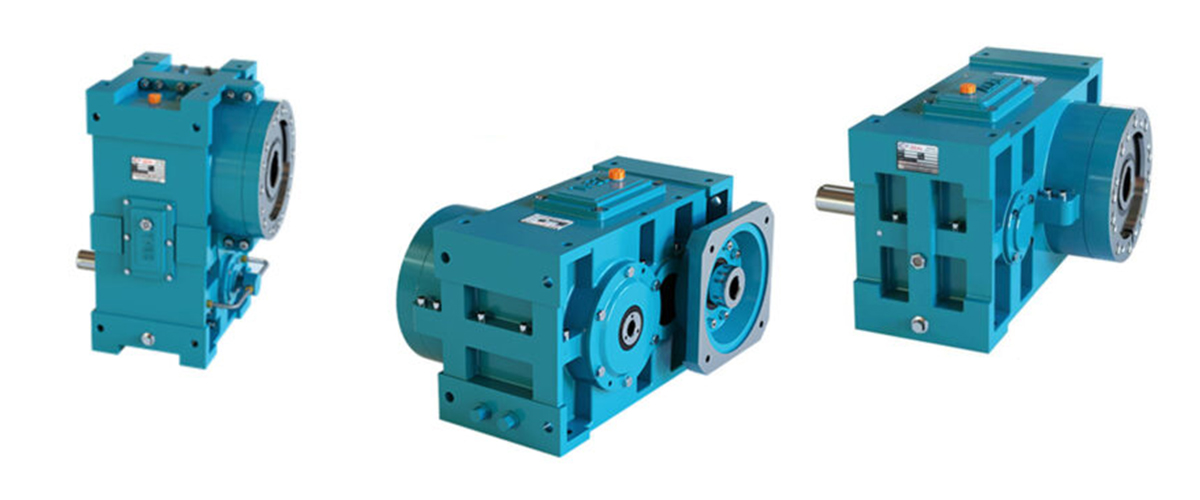
Zeal Gears manufactures gearboxes for both stages of a plastic recycling line. Our shredder helical gearbox range is purpose-built to withstand the shock, vibration, and fluctuating loads generated when shredding rubber and plastic waste, with a cast-iron housing for strength and rigidity, precision-ground alloy steel gears for high torque capacity, and a hollow-shaft construction that mounts directly to the shredder rotor to reduce misalignment and eliminate a separate coupling. Foot-mounted, flange-mounted, and shaft-mounted configurations are available to suit different shredder and granulator layouts.
For the extrusion stage, our single screw and twin screw extruder gearbox ranges cover input torque from 346 Nm up to 25,000 Nm on single-screw configurations, with epoxy-coated internal linings for oil resistance, magnetic drain plugs to filter lubricant contamination, and heat-resistant silicone oil compatibility — features that matter more on the demanding, contamination-prone environment of a recycling line than on a cleaner virgin-material process. See our single screw extruder gearbox and twin screw extruder gearbox specifications for full details. As an ISO 9001 certified manufacturer established in 1996, Zeal Gears has supplied gearboxes to more than 15,000 installations, including plastic granule and recycling applications, and every unit is run through a no-load test before dispatch.
Maintenance Priorities for Recycling-Duty Gearboxes
Because recycling extrusion gearboxes absorb more variable, less predictable loads than their virgin-resin counterparts, a few maintenance practices deserve elevated priority.
- More frequent oil analysis: Given the cyclical torque loading and continuous, multi-shift duty typical of recycling lines, oil condition should be checked more frequently than the interval a lighter, steadier-duty line might use as a baseline.
- Regular thrust bearing inspection tied to screen-changer cycles: Since screen changes are a recurring source of transient thrust load, align thrust bearing inspection intervals with cumulative screen-change cycles as well as running hours.
- Vibration monitoring on shredder and granulator gearboxes: Shock-load components wear differently than steady-torque components, so vibration signature monitoring often catches developing gear tooth or bearing damage on size-reduction equipment earlier than a simple temperature check would.
- Magnetic drain plug inspection: Where fitted, regularly checking and cleaning magnetic drain plugs gives an early, low-cost indicator of developing wear inside the gearbox before it shows up as a performance problem.
- Documented feedstock-mix tracking: Correlating any unusual gearbox temperature, vibration, or wear findings against what feedstock mix the line was running at the time often reveals whether a specific waste stream is placing a disproportionate load on the drive train, information that’s valuable both for maintenance planning and for future gearbox specification.
Frequently Asked Questions
Q1. Why does a recycling extrusion gearbox need a higher torque margin than a virgin-resin gearbox?
Recycled feedstock varies far more in bulk density, moisture content, and melt flow index than virgin resin does, which creates torque spikes throughout a production run rather than just at start-up. A gearbox sized only to one representative feedstock sample often can’t cover the full range a real recycling line will feed it.
Q2. Do gearboxes need to be different for shredders versus extruders on a recycling line?
Yes. Shredder and granulator gearboxes are built primarily for shock-load tolerance from rotor impact against rigid scrap, while extrusion gearboxes are built for continuous torque multiplication and thrust absorption under fluctuating but generally non-impact loading. The two duty profiles call for different design priorities even though both sit on the same production line.
Q3. How does a continuous screen changer affect gearbox thrust bearing life?
Each screen change event creates a temporary pressure disturbance in the melt stream that propagates back through the die and screw as an axial thrust fluctuation. A thrust bearing sized only against steady operating back-pressure, without margin for these recurring transient spikes, will typically fatigue faster than the same bearing would on a line without continuous filtration.
Q4. Should a plastic recycling line use a single-screw or twin-screw gearbox?
Clean, consistent post-industrial regrind generally runs well on a single-screw gearbox. Mixed, wet, or heavily contaminated post-consumer waste more often needs the superior mixing, multi-stage venting, and torque delivery a twin-screw gearbox provides, particularly when output pellets are destined for higher-grade downstream applications.
Q5. What gearbox features matter most for processing low-bulk-density film waste?
Adequate torque margin for the compaction and conveying demand of forced-fed, low-density material is the most important factor, since film feedstock demands proportionally more torque than an equivalent output rate of denser flake or pellet. Smooth, low-vibration torque delivery also matters more here, since film-derived recyclate is often more shear-sensitive than virgin resin of the same nominal grade.
Q6. Does contamination in recycled plastic damage the gearbox directly?
Not usually directly — abrasive contaminants like sand and grit primarily wear the screw and barrel rather than the gearbox itself. However, the broader operating environment contamination creates, including more frequent screen changes and potentially wetter processing conditions, does influence how the gearbox should be built and maintained.
Q7. Does Zeal Gears manufacture gearboxes for both shredding and extrusion stages of recycling?
Yes. Zeal Gears’ shredder helical gearbox range is built for the shock and fluctuating loads of shredding plastic and rubber waste, while our single-screw and twin-screw extruder gearbox ranges cover the melting, degassing, and pelletizing stage of a recycling line, both customised to the customer’s specific application.
Q8. How can I tell if my recycling line’s gearbox is undersized for a new feedstock mix?
Warning signs include rising oil temperature or vibration that coincides with a specific feedstock type, more frequent thrust bearing or seal replacement than the manufacturer’s expected interval, and output-rate surging that wasn’t present on the previous feedstock mix. If several of these appear together after a change in incoming waste stream composition, a torque recalculation against the new feedstock’s characteristics is worth doing.
Q9. What service factor should I use for a recycling extrusion gearbox?
A combined service factor of 1.5 to 1.8 over calculated average running torque is typical, accounting for both feedstock-driven torque variation and thrust fluctuation from continuous filtration, compared with the 1.25 baseline sometimes adequate for a steady, single-source virgin-resin line.
Q10. Can an existing virgin-resin extrusion line be retrofitted with a gearbox suited to recycled content?
Yes, in many cases the extruder itself can continue running blended or recycled feedstock provided the gearbox is reassessed against the wider torque and thrust range the new feedstock introduces, rather than assumed adequate simply because it worked on 100 percent virgin material. A torque and thrust recalculation against your actual planned recycled-content percentage is the right starting point before committing to a blend increase.
Conclusion
Gearboxes in plastic recycling extrusion machines do the same fundamental job as gearboxes anywhere else in extrusion — reduce speed, multiply torque, absorb axial thrust — but they do it against a load profile shaped by everything virgin-resin processing doesn’t have to deal with: inconsistent bulk density, drifting melt flow index, and the pressure disturbances continuous filtration and degassing introduce. Specifying a gearbox against a single representative feedstock sample, rather than the full variability a real waste stream produces, is one of the more common reasons recycling lines see gearbox problems that a virgin-resin line with the same nameplate torque rating never experiences.
Zeal Gears has manufactured shredder, single-screw, and twin-screw gearboxes for plastic processing and recycling applications since 1996. If you’re specifying or upgrading a gearbox for a recycling extrusion line, contact our engineering team with your feedstock type, output target, and process configuration for an application-specific recommendation.
