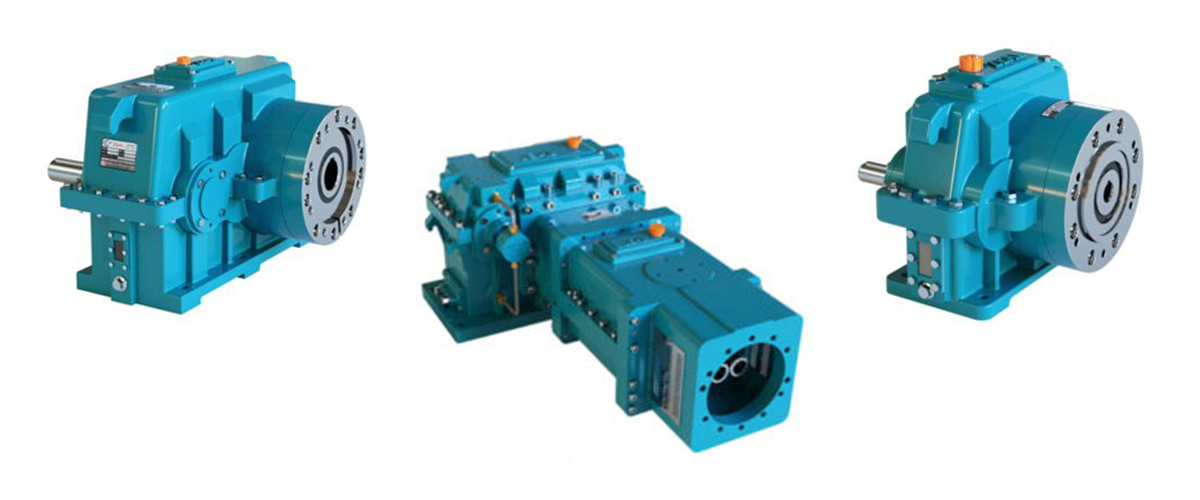
Q1. What is an extruder helical gearbox, and why is it different from a standard helical gearbox?
An extruder helical gearbox is a specialised transmission unit engineered specifically for extrusion machinery. While it shares the helical gear tooth geometry with standard industrial gearboxes, the key difference lies in its integrated thrust bearing assembly. Extrusion screws generate significant axial thrust forces as they push material through the barrel — a load that standard helical gearboxes are not designed to absorb. Extruder-grade units incorporate tandem angular contact bearings or tapered roller bearing arrangements specifically to carry this thrust. Additionally, extruder gearboxes are optimised for continuous duty cycles, with enhanced thermal management, heavy-duty housing design, and output shafts machined for direct screw coupling — features absent in general-purpose helical gearboxes.
Q2. Which industries in Rajkot use extruder helical gearboxes?
Rajkot’s diverse industrial base creates demand for extruder helical gearboxes across multiple sectors. Plastic pipe and fittings manufacturers use them in PVC and HDPE extrusion lines. The cable and wire industry relies on these gearboxes for insulation jacketing extruders. Rubber processing units in the automotive component supply chain use them for seal and profile extrusion. Masterbatch and polymer compounding businesses need twin-screw extruder gearboxes for high-torque compounding lines. Chemical and speciality polymer processors use heavy-duty extruder gearboxes for engineering plastics. Food processing companies with starch or cereal extrusion equipment also require food-grade compatible extruder gearboxes. Each application has unique torque, speed, and configuration requirements that Zeal Gears addresses with application-specific solutions.
Q3. How do I determine the correct gear ratio for my extruder gearbox?
The gear ratio for your extruder helical gearbox is determined by dividing your drive motor’s rated speed (RPM) by the required extruder screw speed (RPM). For example, if your motor operates at 1,450 RPM and your screw requires 100 RPM, the required gear ratio is 14.5:1. However, in practice, extruder gearbox selection involves more than just the ratio — you must also verify that the gearbox delivers the required torque at that output speed, that the thrust bearing capacity exceeds peak axial load, and that the gearbox’s power rating matches the motor’s output. It is strongly recommended to share your extruder specifications — screw diameter, motor power, screw speed range, and material being processed — with our engineering team for a validated recommendation.
Q4. What is the typical torque capacity of an extruder helical gearbox?
Torque capacity in extruder helical gearboxes varies significantly with application requirements. For small single-screw extruders (25–45 mm screw diameter) processing commodity plastics, output torque may range from 500 Nm to 2,000 Nm. For medium-duty lines (50–90 mm screws), torque requirements typically fall between 2,000 Nm and 8,000 Nm. Large-diameter extrusion lines (90–200 mm screws) and heavy-duty twin-screw compounders may require 8,000 Nm to 50,000+ Nm. In extruder gearbox engineering, specific torque (torque per unit cube of centre distance, expressed as Nm/cm³) is a more meaningful measure of gearbox capacity relative to size. Modern high-torque extruder gearboxes achieve specific torque values of 13–18 Nm/cm³. Zeal Gears manufactures across the full torque range, customised to your application.
Q5. What maintenance schedule should I follow for an extruder gearbox in a continuous production environment?
For extruder helical gearboxes operating in continuous production — defined as 16–24 hours per day — the following maintenance schedule is recommended: Perform the first oil change at 500 hours to remove run-in wear debris and any manufacturing residues. Subsequently, change the lubricant every 2,500 to 4,000 hours, or every six months, whichever comes first — with shorter intervals if operating at elevated temperatures. Inspect shaft seals monthly for any sign of oil seeping, and replace immediately if detected. Check coupling alignment every 1,000 hours or after any machine movement. Monitor oil temperature during operation — consistent readings above 85°C indicate a need for investigation. Conduct annual thorough inspections including gear and bearing condition assessment. Following this schedule, Zeal Gears extruder gearboxes regularly achieve 20,000+ hours of service life in demanding production environments.
Q6. Can Zeal Gears supply a gearbox as a replacement for my existing extruder unit?
Yes, Zeal Gears has significant experience supplying replacement extruder helical gearboxes for existing machinery — including replacing units from domestic and imported extruder manufacturers. Our engineering team collects the key dimensional data from your existing gearbox: mounting bolt pattern, input and output shaft dimensions, centre distance, gear ratio, and coupling interface. We also review your extruder’s torque and speed requirements. Based on this data, we engineer a compatible replacement unit that meets or exceeds the original specification. In most cases, we can supply direct drop-in replacements with identical mounting dimensions, eliminating the need for machine modifications. Share your existing gearbox’s nameplate data, photographs, and dimensional drawings with our team for a feasibility assessment and quotation.
Q7. What is the difference between a co-rotating and counter-rotating twin-screw extruder gearbox?
Co-rotating and counter-rotating refer to the direction of rotation of the two screws in a twin-screw extruder, and the gearbox architecture is fundamentally different for each type. In a co-rotating twin-screw extruder, both screws rotate in the same direction. The gearbox uses an intermediate idler gear stage to reverse the rotational direction of one output, with both shafts emerging from the same face of the gearbox. Co-rotating units are widely used in compounding, masterbatch production, and reactive extrusion because of their superior mixing characteristics. In counter-rotating twin-screw extruders, the screws rotate in opposite directions. The gearbox achieves this through direct opposite-hand gearing without an idler stage, and the screws may be parallel or conical. Counter-rotating designs are predominantly used in PVC pipe and profile extrusion. Zeal Gears designs and manufactures both configurations, engineered to your specific screw geometry, centre distance, and torque requirement.
Q8. How does an extruder helical gearbox handle axial thrust loads?
Axial thrust management is one of the most critical design challenges in extruder gearbox engineering. As the extrusion screw rotates and pushes material through the barrel, it experiences a strong reactive thrust force directed backward along its axis — effectively trying to push the screw out of the barrel. This axial force must be absorbed entirely by the gearbox’s thrust bearing assembly. In well-designed extruder gearboxes, this is achieved using tandem angular contact ball bearings or matched sets of tapered roller bearings arranged to carry load in both axial directions. The bearing arrangement is designed with a calculated safety factor that accounts for both normal operating thrust and transient overloads during start-up or die blockage events. The gearbox housing and bearing seats are machined to extremely tight tolerances to ensure the bearings operate under the correct preload. Inadequate thrust capacity is the leading cause of extruder gearbox failure — it is essential to verify this rating before purchase.
Q9. Are Zeal Gears extruder gearboxes compatible with variable frequency drive (VFD) motor systems?
Yes, all Zeal Gears extruder helical gearboxes are fully compatible with variable frequency drive systems. Modern extrusion lines almost universally use VFD-controlled motors to enable precise screw speed adjustment and soft-start capability. When a gearbox is used with a VFD drive, several design considerations become important: the lubrication system must be effective across the full operating speed range, including at low speeds where splash lubrication may be marginal — forced lubrication is recommended for wide-range VFD applications. Additionally, insulated bearings should be specified to prevent bearing damage from VFD-induced shaft currents, a common issue with high-power VFD systems. Our engineering team accounts for VFD compatibility in every application review and can recommend appropriate specification upgrades where necessary. Please advise your motor’s VFD specification when requesting a gearbox quotation.
Q10. What warranty and after-sales support does Zeal Gears provide for gearboxes supplied to Rajkot?
Zeal Gears provides structured warranty coverage on all extruder helical gearboxes, covering manufacturing defects in materials and workmanship. The warranty period and terms are outlined in the supply documentation and are applicable when the gearbox is operated within its rated parameters and maintained per our guidelines. Beyond warranty, our after-sales support includes technical consultation on installation and commissioning, lubrication specification and supply guidance, periodic maintenance advisory services, supply of original spare parts including bearings, seals, and gear components, and field service support for troubleshooting and repairs. Our team provides responsive support to industrial customers in Rajkot and across Gujarat, with the ability to dispatch technical personnel for on-site assistance. We also maintain a stock of critical spare parts — particularly bearings and seals — to minimise lead times for urgent maintenance requirements.