
Introduction
Bolt a gearbox built for HDPE pipe extrusion onto a rigid PVC line and, on paper, the torque and power numbers might even look adequate. In practice, the line will likely run hotter, wear faster, and produce more scrap than a gearbox actually matched to how PVC behaves in the barrel. Unplasticized PVC is not simply “another thermoplastic” from a drive-train perspective — its narrow thermal degradation window, its reliance on mechanical rather than viscous melting, and its abrasive filler content place a different, and in several ways more demanding, set of requirements on the gearbox for PVC pipe extrusion than HDPE, PP-R, or PE-RT do. This guide sets out exactly what those requirements are: why the overwhelming majority of rigid PVC pipe lines run on twin-screw rather than single-screw gearboxes, what torque, synchronization, thrust, and lubrication specifications actually matter, and how to size and maintain a gearbox correctly for continuous PVC duty.
What Makes PVC Different From Other Extrusion Polymers
Rigid PVC (uPVC) is almost always fed into the extruder as a dry-blend powder compound, not pre-compounded pellets, and this single fact drives most of the differences in gearbox requirement compared with HDPE or PP pipe extrusion.
Torque, Not Horsepower, Turns the Screw
With a given motor horsepower, the torque a gearbox can deliver is fixed by the maximum screw speed the gear ratio allows — the same relationship as low gear in a vehicle. PVC dry blend is far more torque-demanding to start moving from cold than an equivalent HDPE pellet feed, because the powder has to be compacted, conveyed, and mechanically worked before it begins to melt, rather than simply dragged along a barrel wall by viscous shear the way pellets are.
A Narrow Thermal Degradation Window
PVC begins to degrade thermally at temperatures not far above its normal processing range, releasing trace hydrochloric acid as it does. This means the gearbox and screw combination must deliver melting primarily through mechanical and conductive heat rather than through the frictional shear heating a single-screw HDPE extruder relies on — running the material hotter for longer to compensate for a torque-limited gearbox is not a viable workaround the way it sometimes is with more thermally stable polymers.
Abrasive and Corrosive Filler Content
Rigid PVC pipe compounds commonly include calcium carbonate and other mineral fillers for cost and impact-modification reasons. These fillers are abrasive to screw and barrel surfaces over time, and combined with the trace hydrochloric acid released under any localised overheating, create a more corrosive operating environment inside the extruder than a filler-free HDPE compound does. None of this load reaches the gearbox directly, but it does mean the gearbox has to deliver highly consistent, well-controlled torque and speed to avoid the localised shear spikes that accelerate both wear and degradation.
Particle Size, K-Value, and Torque Variability
Two PVC dry-blend formulations with the same nominal K-value — the industry measure of resin molecular weight — can still demand noticeably different torque depending on resin particle size, the type and loading of impact modifiers, and how thoroughly the powder was pre-blended before feeding. A gearbox specified against a single, best-case formulation’s torque figure can be undersized the moment the plant switches to a different supplier’s resin batch or a higher-impact-modifier pipe grade. This is one of the more overlooked reasons a PVC pipe line’s gearbox needs headroom built in through the service factor rather than being sized to a single formulation’s calculated torque figure alone.
Why Most PVC Pipe Lines Run on Twin-Screw Gearboxes, Not Single-Screw
A single-screw extruder transports and melts material largely through viscous drag against the barrel wall — the same shear that generates heat also generates the conveying force. Counter-rotating twin screws work differently: because the intermeshing flights transport material mechanically, the screws can run only partially filled for much of their length, which sharply reduces shear-induced viscous heating. Twin-screw extruders can achieve as much as 70 percent of total melting through conducted rather than viscous heat, which is precisely the melting behaviour a thermally sensitive material like PVC needs.
This has a direct gearbox consequence: because counter-rotating twin screws do not rely on shear for conveying, they typically do not require the same torque for a given output rate that an equivalent single-screw line would. However, the gearbox itself becomes mechanically more demanding, because it now has to drive and precisely synchronize two shafts — long and short, or left and right — at an identical angular position under all load conditions, so the intermeshing screw flights never make mechanical contact.
Torque Density and Center Distance
For a twin-screw gearbox, torque density — the torque delivered per shaft relative to the cube of the center distance between the two shafts — is the key performance figure gearbox engineers work to, rather than a simple output torque number in isolation. At a fixed center distance, the ratio of outer to inner screw diameter (Do/Di) is set as high as practically possible, and the output shaft diameter is kept only as large as the maximum torsional stress requires, so that more of the available space goes to process volume rather than mechanical bulk. This is why two twin-screw gearboxes with the same output torque rating can perform very differently on a PVC line if their torque density and Do/Di design differ.
Co-Rotating vs Counter-Rotating: Why It Matters for the Gearbox
Co-rotating twin screws, where both shafts turn in the same direction, generate intense self-wiping action and high shear — useful for compounding, but generally too aggressive on the thermal-degradation front for rigid PVC pipe production. Counter-rotating twin screws, where the shafts turn in opposite directions, are the standard choice for PVC pipe extrusion precisely because they control shear heating far more gently. From a gearbox design standpoint, counter-rotating operation places a different, generally higher, demand on shaft synchronization than co-rotating designs, since the two screws are working against rather than with each other’s rotational direction at the intermesh point, which is one more reason PVC-specific gearboxes are engineered differently from gearboxes built primarily for compounding duty.
Core Gearbox Requirements for a PVC Pipe Extrusion Line
Bringing the material behaviour and mechanical design together, these are the specific requirements a gearbox needs to meet on a rigid PVC pipe extrusion line.
- High starting torque for cold dry-blend feed: The gearbox must handle the torque spike of compacting and conveying cold PVC powder at start-up, which is typically higher relative to running torque than the equivalent spike on a pellet-fed HDPE line.
- Precise 1:1 dual-shaft synchronization: Whether parallel or conical, the two output shafts must maintain an identical angular position under all load conditions so the intermeshing flights never contact each other, which would instantly damage both screws and the gearbox.
- Heavy-duty thrust bearing on both shafts: Counter-rotating twin screws generate substantial axial back-pressure on each shaft independently, so both output shafts need adequately rated thrust bearings, not just the single bearing arrangement a single-screw gearbox requires.
- Tight output-speed regulation: Because PVC wall-thickness tolerance is sensitive to even small speed fluctuations, the gearbox needs consistent, low-backlash gear engagement rather than the wider tolerance acceptable on some other extrusion duties.
- Forced lubrication with reliable cooling: The combination of continuous duty, high torque density, and the heat-sensitivity of PVC means splash lubrication is rarely sufficient — most PVC pipe line gearboxes need a motor-driven oil pump, filter, and external cooler as standard, not an optional upgrade.
- Wear- and corrosion-resistant internals: While filler abrasion mainly affects the screw and barrel rather than the gearbox directly, epoxy-coated or oil-resistant internal linings and magnetic drain plugs that capture wear particulate from the lubrication circuit extend gearbox service life in the more demanding PVC operating environment.
- A service factor set for frequent recipe and diameter changes: PVC pipe manufacturers often run multiple pipe classes, wall thicknesses, and formulations through the same line, and each changeover reintroduces a cold-start torque spike that the gearbox’s service factor needs to account for.
Parallel vs Conical Twin-Screw Gearboxes for PVC
Twin-screw gearboxes for PVC pipe extrusion come in two mechanical layouts, and the right choice depends on pipe diameter range, output target, and existing barrel geometry.
| Factor | Parallel Twin-Screw Gearbox | Conical Twin-Screw Gearbox |
| Shaft Arrangement | Two shafts at equal, fixed center distance | Long and short shaft driving screws at matched angle, 1:1 ratio |
| Typical Application | Higher-output, larger-diameter pipe lines | Small to mid-range pipe and profile lines |
| Feed Section | Larger feed throat for higher output rates | Deeper feed section suits powder compaction well |
| Relative Cost | Generally higher for equivalent torque | Generally more cost-effective at lower output |
| Center Distance (typical) | Wider range at higher torque ratings | Commonly 18.5 mm to 76 mm on smaller units |
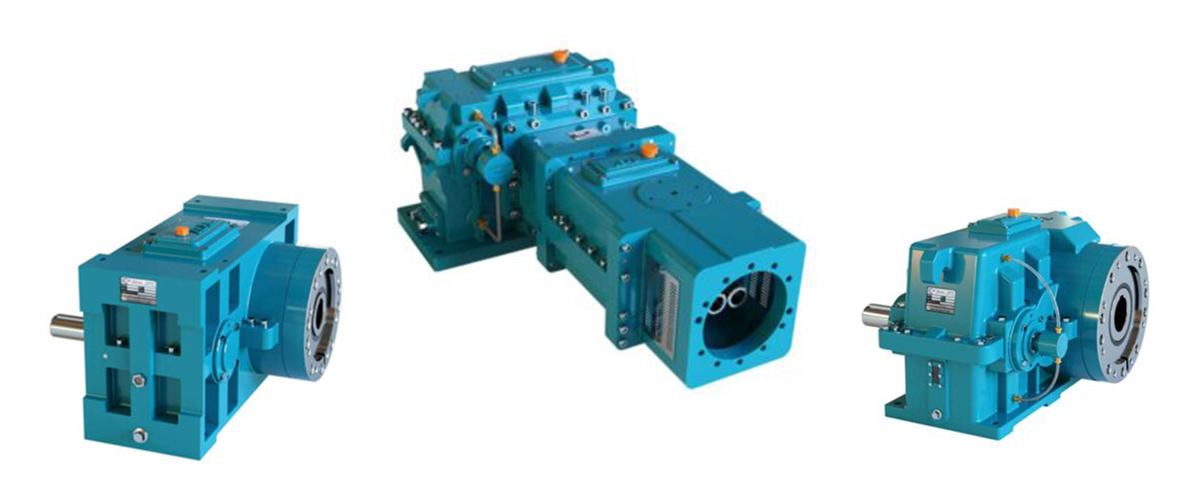
Zeal Gears manufactures both configurations: a conical SZ-series twin-screw gearbox built to drive matched long and short shafts at a 1:1 ratio for smaller and mid-range PVC pipe lines, and a twin-shaft parallel configuration available across an 18.5 mm to 76 mm center-distance range, sized to customer torque and output requirements.
Sizing a Gearbox for PVC-Specific Torque Demand
Sizing a PVC pipe extrusion gearbox follows the same underlying torque, service-factor, and thrust logic used across extrusion gearbox selection generally, but three inputs need to be set differently to reflect how PVC actually processes.
- Size against the cold dry-blend torque spike, not the molten running torque: Because PVC powder compaction demands more relative starting torque than pellet feed, the worst-case torque point on most PVC lines occurs at start-up or immediately after a recipe change, not during steady continuous running.
- Use a service factor toward the higher end of the standard range: Given the frequency of diameter and recipe changeovers common on PVC pipe operations, a service factor of 1.5 to 1.8 over calculated running torque is typical, compared with the 1.25 baseline sometimes adequate for a single-product, continuous HDPE line.
- Size thrust bearings on both shafts independently: Unlike a single-screw gearbox where one thrust bearing absorbs the full back-pressure, each shaft on a counter-rotating twin-screw gearbox needs its own thrust capacity verified against the axial load your screw geometry and die restriction generate.
- Confirm torque density against center distance, not just absolute torque: Two gearboxes rated at the same output torque can behave very differently on a PVC line depending on their Do/Di ratio and center distance — ask your supplier for the torque-density figure, not just the headline Nm rating.
- Verify the gear ratio against your dry-blend screw-speed range: PVC pipe lines commonly run at lower screw speeds than HDPE lines processing an equivalent pipe diameter, so confirm the ratio delivers your required rpm window at standard motor speed rather than assuming an HDPE-line ratio will transfer directly.
Worked Example: A conical twin-screw line producing 110mm PVC pipe at a target output of 180 kg/hr might calculate a steady running torque of approximately 2,600 Nm per shaft under standard formulation. Because the plant regularly switches between three pipe classes on the same line, a service factor of 1.6 is applied to cover the recurring cold-start and recipe-change torque spikes, raising the required rated torque to roughly 4,150 Nm per shaft — a figure a gearbox catalogued at 3,500 Nm per shaft would fall short of, even though it would look adequate against the base running-torque calculation alone.
Common Mistakes When Specifying a Gearbox for PVC Pipe Extrusion
PVC-specific gearbox selection errors tend to repeat across the industry because they are easy to make when a PVC line is specified using the same checklist as an HDPE line.
- Sizing against molten running torque instead of the cold start-up spike: Because PVC dry-blend compaction demands proportionally more torque from cold than pellet feed, a gearbox sized only to steady-state running torque is frequently undersized for the start-up condition it will face every shift.
- Applying an HDPE-line service factor to a PVC line: A 1.25 service factor that is adequate for a steady, single-product HDPE line rarely covers the frequency of recipe and diameter changeovers typical on a PVC pipe operation.
- Checking only one shaft’s thrust bearing on a twin-screw gearbox: Both output shafts on a counter-rotating twin-screw unit carry independent axial loads, and verifying only one leaves the other unchecked against its actual back-pressure.
- Assuming a single torque figure covers every formulation the line will run: Different resin batches, K-values, and impact-modifier loadings can shift torque demand meaningfully, so a gearbox sized to one best-case formulation may be undersized once the plant’s product mix broadens.
- Treating splash lubrication as sufficient by default: Many PVC lines run continuously enough, and generate enough heat from high torque density, that forced lubrication with an external cooler is necessary even where a lower-duty application might get by on splash lubrication alone.
- Overlooking synchronization tolerance during specification: Backlash and synchronization accuracy between the two output shafts rarely appear on a basic torque-and-power datasheet, but they directly determine whether the screws stay clear of each other under load over the gearbox’s service life.
Zeal Gears Gearboxes for PVC Pipe Extrusion
Zeal Gears manufactures both the single-screw and twin-screw configurations used across rigid PVC pipe extrusion. Our single-screw extruder gearbox range covers an input power of 2 to 250 kW, an input torque of 346 to 25,000 Nm, and screw diameters from 20 to 200 mm, with epoxy-coated internal linings for oil resistance and magnetic drain plugs that filter wear particulate from the lubrication circuit — both details that matter more on the more demanding PVC duty cycle than on a lighter-duty application.
For compounding-fed and higher-torque PVC lines, our twin screw extruder gearbox range is engineered to synchronize two intermeshing shafts precisely under load, with robust construction and efficient cooling provision built in for continuous high-torque duty, available in a twin-shaft configuration across an 18.5 mm to 76 mm center-distance range and customised to your specific pipe diameter and output target.
Established in 1996, Zeal Gears is an ISO 9001 certified manufacturer with more than 15,000 installations across plastic pipe, blown film, blow moulding, and plastic granule applications, among others, and every gearbox is run through a no-load test before dispatch.
Maintenance Considerations Specific to PVC Duty
PVC’s abrasive filler content and thermal sensitivity mean a few maintenance practices deserve more attention on a PVC line than they might on an HDPE line running the same gearbox family.
- Monitor oil condition more frequently: The combination of continuous duty and finer wear particulate from a more abrasive process environment can accelerate additive depletion in the lubricant, so oil analysis intervals are often shortened on PVC lines relative to HDPE duty.
- Check dual-shaft synchronization regularly: Any drift in the 1:1 timing between the two output shafts on a twin-screw gearbox risks flight contact between the screws, so synchronization and backlash should be part of the routine inspection schedule, not just an installation-time check.
- Inspect thrust bearings on both shafts independently: Because each shaft carries its own axial load on a counter-rotating twin-screw unit, a bearing inspection that only checks one side can miss developing fatigue on the other.
- Watch for recipe-change-related temperature spikes: A gearbox running noticeably hotter after a formulation or diameter change, even briefly, is worth investigating before it becomes a recurring pattern, since PVC’s narrow thermal window leaves less margin for a developing lubrication or alignment issue than a more thermally tolerant polymer would.
- Keep spare thrust bearings and seals on hand: Given that thrust bearing fatigue is a more common limiting factor on PVC duty than on lighter-duty applications, keeping a spare set on site shortens the downtime window if a scheduled inspection reveals wear approaching its replacement point.
None of these practices differ dramatically from good gearbox maintenance generally, but the frequency at which they need to happen, and the margin for error before a developing issue becomes a failure, is noticeably tighter on a PVC line than on many other extrusion applications — which is exactly why the gearbox itself needs to be specified for PVC duty from the outset rather than adapted from a general-purpose extrusion unit after the fact.
Frequently Asked Questions
Q1. Why do PVC pipe lines usually need a twin-screw gearbox instead of single-screw?
Rigid PVC is heat-sensitive and processed from dry-blend powder, which counter-rotating twin screws handle better because they melt material mainly through mechanical and conducted heat rather than the viscous shear heating a single screw relies on. This keeps processing temperature within PVC’s narrow degradation window more reliably than single-screw processing typically allows.
Q2. What torque rating does a PVC pipe extrusion gearbox need?
It depends on pipe diameter, output target, and screw geometry, but as a planning guide, smaller PVC pipe and profile lines commonly use gearboxes in the low thousands of Nm range, while larger production lines need considerably more. Always size against the cold dry-blend start-up torque spike, not the steady molten running torque, and apply an appropriate service factor on top.
Q3. What service factor should I use for a PVC pipe extrusion gearbox?
Because PVC lines commonly change pipe diameter, wall thickness, or formulation several times a shift, a service factor of 1.5 to 1.8 over calculated running torque is typical, higher than the 1.25 baseline sometimes adequate for a single-product, continuous-duty HDPE line.
Q4. What is torque density and why does it matter for PVC twin-screw gearboxes?
Torque density is the torque delivered per shaft relative to the cube of the center distance between the two shafts, and it is a more meaningful comparison figure than absolute output torque alone when evaluating twin-screw gearboxes. A higher torque density at a given center distance generally means a more compact, more efficient gear design for the same processing capability.
Q5. Can the same gearbox process both PVC and HDPE on the same line?
It’s possible if the gearbox was sized for PVC’s higher relative starting torque and fitted with a thrust bearing arrangement adequate for both materials’ back-pressure characteristics, but it should be confirmed against both materials’ specific torque and thrust demands rather than assumed. Lines that regularly switch between PVC and HDPE should be sized to the more demanding of the two conditions.
Q6. How is a conical twin-screw gearbox different from a parallel twin-screw gearbox?
A conical twin-screw gearbox drives a long and short shaft at a matched angle through a 1:1 drive ratio to power tapered conical screws, commonly used on small to mid-range PVC pipe and profile lines. A parallel twin-screw gearbox drives two shafts at a fixed, equal center distance and is more common on higher-output, larger-diameter pipe production.
Q7. What causes premature wear in a PVC pipe extrusion gearbox?
The most common causes are inadequate lubrication for the continuous-duty cycle, synchronization drift between the two output shafts on a twin-screw unit, and thrust bearing fatigue from underestimated axial load calculations. Because PVC processing environments run more abrasive and thermally sensitive than many other extrusion applications, oil condition and synchronization should be checked more frequently than on a lighter-duty line.
Q8. Does Zeal Gears manufacture gearboxes specifically for PVC pipe extrusion?
Yes. Zeal Gears manufactures both single-screw gearboxes, covering 346 to 25,000 Nm of input torque, and twin-screw gearboxes in parallel and conical configurations across an 18.5 mm to 76 mm center-distance range, sized and customised to your specific PVC pipe diameter, output target, and formulation.
Q9. How often should I change gearbox oil on a PVC pipe extrusion line?
PVC’s continuous duty and more abrasive processing environment tend to accelerate lubricant additive depletion compared with lighter-duty applications, so oil condition should be checked on a running-hours basis and confirmed through periodic oil analysis rather than a fixed calendar interval. Shorten the interval if analysis shows faster-than-expected wear-particulate accumulation.
Q10. What happens if a twin-screw gearbox loses synchronization on a PVC line?
Loss of the precise 1:1 angular timing between the two output shafts risks the intermeshing screw flights making mechanical contact, which can damage both screws and the gearbox internals almost immediately. Regular synchronization and backlash checks as part of routine maintenance catch drift before it reaches that point.
Q11. Can Zeal Gears customize a twin-screw gearbox for an existing PVC line?
Yes. Zeal Gears’ twin-shaft configuration is available across an 18.5 mm to 76 mm center-distance range and can be customised in torque rating, ratio, and mounting to match an existing PVC extruder, which is generally more cost-effective than modifying the extruder to fit a standard gearbox.
Conclusion
A gearbox for PVC pipe extrusion has to be selected against a different set of demands than one built for HDPE or PP pipe lines: a higher relative starting torque from cold dry-blend feed, precise dual-shaft synchronization on twin-screw configurations, independently rated thrust bearings on both shafts, and forced lubrication sized for continuous, abrasive, thermally sensitive duty. Sizing to the same kilowatt figure that would work on an HDPE line, without accounting for these PVC-specific requirements, is one of the more common and more costly gearbox selection mistakes in pipe manufacturing.
Zeal Gears has manufactured single-screw and twin-screw extruder gearboxes for the plastic pipe industry since 1996. If you’re specifying or upgrading a gearbox for a rigid PVC pipe extrusion line, contact our engineering team with your pipe diameter, output target, and formulation details for an application-specific torque and thrust calculation.
