
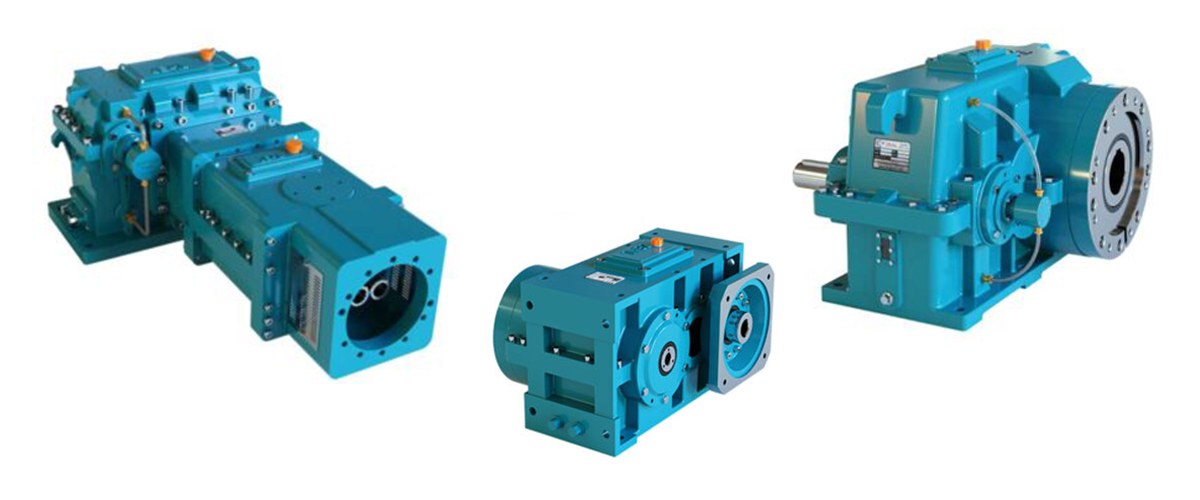
When it comes to selecting a gearbox for a plastic extrusion machine, one question comes up more often than almost any other: should I use a helical gearbox or a worm gearbox? At first glance, both types achieve the same basic function — they reduce motor speed and increase torque to drive the extruder screw. Both are available in the gear ratios and power ratings relevant to extrusion. Both are offered at competitive prices by a wide range of manufacturers. Yet the two gear types are fundamentally different in their internal design, their operating principles, their efficiency, their heat generation, their load capacity, and their suitability for the specific and demanding conditions of continuous plastic extrusion. Choosing the wrong type does not just mean a slightly suboptimal drive system — it can mean 30% to 50% higher energy consumption, excessive heat that degrades lubricant and shortens service life, inadequate torque for demanding materials, and premature gearbox failure that brings the entire production line to a halt. This complete comparison guide examines both gearbox types in detail — how each one works, where each one performs well, where each one has limitations, and why the choice between them for plastic extrusion applications is, in the vast majority of cases, not a close decision at all. By the end of this guide, you will have a clear, technically grounded understanding of which gearbox type is right for your extrusion machine and why.
How a Helical Gearbox Works — Design and Operating Principle
A helical gearbox transmits power through a series of helical gear pairs — gears whose teeth are cut at an angle (the helix angle, typically 15 to 30 degrees) relative to the shaft axis. This angled tooth geometry means that as two helical gears mesh, the contact between the teeth does not occur all at once across the full tooth width. Instead, contact begins at one end of the tooth and progresses gradually along the helix until the full tooth face is engaged, before disengaging equally gradually at the other end.
At any given instant, multiple teeth are partially engaged simultaneously — creating what engineers call a high contact ratio. This overlapping tooth engagement is the defining characteristic of helical gear power transmission, and it is the source of virtually every performance advantage the helical gearbox offers over alternative gear types.
In a plastic extruder gearbox, two or three stages of helical gear pairs are arranged in series within the gearbox housing, each stage reducing speed and multiplying torque. The input shaft (connected to the motor) carries the first-stage pinion. Power flows through each gear stage to the output shaft (connected to the extruder screw), which delivers high torque at low speed to drive the screw. All shafts are parallel to each other — a configuration that keeps the gearbox compact and easy to align.
Helical Gearbox — Key Design Facts
Gear tooth orientation: Angled (helical) — typically 15 to 30 degree helix angle
Shaft arrangement: Parallel input and output shafts
Power transmission: Through multiple simultaneously engaged gear teeth
Gear stages: 2 or 3 stages in series for typical extrusion ratios
Mechanical efficiency: 95% to 98% per gearbox (typical for extrusion duty units)
Torque capacity: Very high — limited by tooth bending strength and contact stress
Speed reduction range: 8:1 to 100:1 (two or three stages)
Axial thrust handling: Dedicated heavy-duty thrust bearing in extruder-specific designs
How a Worm Gearbox Works — Design and Operating Principle
A worm gearbox transmits power through the meshing of two fundamentally different components: a worm (a screw-like helical thread wrapped around a cylindrical shaft, resembling a threaded bolt) and a worm wheel (a large gear with specially curved teeth designed to mesh with the worm thread). The worm is mounted on the input shaft, and the worm wheel is mounted on the output shaft. The two shafts are oriented at 90 degrees to each other — a characteristic that distinguishes the worm gearbox from all parallel-shaft gear types.
Power transmission in a worm gearbox occurs through a sliding contact mechanism. As the worm rotates, its thread slides across the curved tooth faces of the worm wheel, pushing the wheel teeth forward. Unlike the rolling contact that occurs between helical gear teeth, the contact in a worm gear pair is predominantly sliding — the worm thread slides along the worm wheel tooth profile throughout the entire engagement.
This sliding contact is the fundamental reason why worm gearboxes behave so differently from helical gearboxes in terms of efficiency, heat generation, wear rate, and continuous duty performance. Sliding friction converts a significant proportion of the transmitted power into heat — heat that must be dissipated from the gearbox housing, that heats and degrades the lubricating oil, and that accelerates wear on both the worm thread and the worm wheel tooth surfaces.
Worm Gearbox — Key Design Facts
Gear tooth orientation: Worm thread (input) meshes with worm wheel teeth (output)
Shaft arrangement: Input and output shafts at 90 degrees to each other
Power transmission: Through predominantly sliding contact between worm and wheel
Gear stages: Single stage achieves high ratios (5:1 to 100:1)
Mechanical efficiency: 50% to 90% depending on gear ratio and lead angle
Torque capacity: Limited by bronze wheel tooth contact stress and wear rate
Speed reduction range: 5:1 to 100:1 in a single stage
Axial thrust handling: Standard worm gearboxes not designed for sustained axial screw loads
The Fundamental Mechanical Difference Between the Two Types
The single most important mechanical difference between a helical gearbox and a worm gearbox — the difference from which almost every other performance distinction flows — is the nature of the contact between the gear elements that transmit power.
In a helical gearbox, the mating gear teeth roll against each other. The contact patch between a helical pinion tooth and a helical wheel tooth moves across the tooth surface as the gears rotate, but the motion at the contact point is primarily rolling, with a small sliding component. This is called rolling contact, and it generates very little friction — which is why helical gearboxes are so efficient.
In a worm gearbox, the worm thread slides across the worm wheel tooth face throughout the entire engagement. There is no rolling component — the contact is almost entirely sliding. High-velocity sliding contact between metal surfaces generates far more friction than rolling contact, which is why worm gearboxes are inherently less efficient. The energy lost to friction appears as heat, concentrated at the worm-wheel contact zone.
Rolling Contact vs Sliding Contact — The Core Difference
Helical Gearbox: Rolling contact between gear teeth
Low friction → Low heat generation → High efficiency (95–98%)
Worm Gearbox: Sliding contact between worm thread and wheel teeth
High friction → High heat generation → Lower efficiency (50–90%)
This single difference determines efficiency, heat, wear rate, and continuous duty suitability.
It is the reason why helical gearboxes dominate in high-power, continuous-duty extrusion applications.
The worm gearbox compensates for its lower efficiency with genuine advantages in compactness and self-locking capability — in a single compact stage, it achieves gear ratios that would require two or three stages of helical gears. And at low power levels with intermittent duty cycles, the efficiency disadvantage is manageable. But in a plastic extrusion application running continuously at high power for many hours per day, the efficiency difference between rolling contact and sliding contact has profound and quantifiable consequences.
Head-to-Head Comparison: 12 Performance Criteria
The following table provides a direct, criterion-by-criterion comparison of helical and worm gearboxes across the twelve performance factors that matter most in plastic extrusion applications. Each criterion is scored and explained in detail in the sections that follow.
| Performance Criterion | Helical Gearbox | Worm Gearbox | Winner |
| Mechanical Efficiency | 95% – 98% | 50% – 90% (ratio dependent) | Helical |
| Heat Generation | Low — minimal power loss as heat | High — significant power lost as heat | Helical |
| Continuous Duty Torque | Very high — rolling contact | Moderate — sliding contact limits load | Helical |
| Noise Level | Low — gradual tooth engagement | Low — but gear mesh can whine at speed | Helical |
| Vibration Level | Very low | Low to medium | Helical |
| Thrust Load Capacity | Excellent — purpose-rated thrust bearing | Not designed for sustained axial load | Helical |
| Speed Ratio Range | 8:1 to 100:1 (2–3 stages) | 5:1 to 100:1 (single stage) | Equal |
| Physical Compactness | Moderate — parallel shaft layout | Very compact — 90° shaft arrangement | Worm |
| Service Life (extrusion) | 10 – 20+ years continuous duty | 3 – 8 years at high continuous load | Helical |
| Maintenance Frequency | Low — oil change every 3,000–5,000 h | High — bronze wheel wears faster | Helical |
| Purchase Price | Higher initial cost | Lower initial cost | Worm |
| Total Cost of Ownership | Lower — less energy, less downtime | Higher — energy + wear cost over time | Helical |
The comparison table tells a clear story: the helical gearbox wins on 10 out of 12 criteria for extrusion applications. The worm gearbox wins on compactness and initial purchase price — two factors that are relevant to installation but are dwarfed in significance by efficiency, torque capacity, heat generation, and service life when the machine runs continuously for years. The sections that follow examine each critical difference in depth.
Efficiency — The Most Critical Difference for Extrusion
Of all the differences between helical and worm gearboxes, efficiency is the one that has the most immediate, measurable, and financially significant impact on a plastic extrusion operation. It deserves the most detailed examination.
Understanding Worm Gearbox Efficiency Variation
Unlike helical gearbox efficiency, which is relatively constant across the normal operating range (95% to 98% regardless of gear ratio), worm gearbox efficiency varies dramatically with the gear ratio. This is because efficiency depends on the worm lead angle — the angle of the worm thread — and the lead angle decreases as the gear ratio increases.
Shaft Material Requirements
Extruder gearbox shafts are manufactured from medium-carbon alloy steels that are through-hardened and tempered to achieve high tensile strength, good fatigue resistance, and adequate toughness. Unlike the gears, which use case-hardening steels to achieve a hard surface over a tough core, the shafts use through-hardening steels that develop their mechanical properties uniformly through the full cross-section.
| Gear Ratio | Worm Lead Angle | Worm Gearbox Efficiency | Helical Gearbox Efficiency | Efficiency Gap |
| 5 : 1 | ~20° | 85 – 90% | 97% | 7 – 12% |
| 10 : 1 | ~14° | 78 – 85% | 97% | 12 – 19% |
| 15 : 1 | ~10° | 72 – 80% | 96% | 16 – 24% |
| 20 : 1 | ~8° | 68 – 76% | 96% | 20 – 28% |
| 30 : 1 | ~6° | 62 – 72% | 95% | 23 – 33% |
| 40 : 1 | ~5° | 58 – 68% | 95% | 27 – 37% |
| 50 : 1 | ~4° | 52 – 62% | 94% | 32 – 42% |
| 63 : 1 | ~3.5° | 48 – 58% | 94% | 36 – 46% |
| 80 : 1 | ~2.8° | 42 – 55% | 93% | 38 – 51% |
This table reveals the full scale of the efficiency problem with worm gearboxes at high gear ratios. For PVC extrusion, which typically requires a gear ratio of 40:1 to 63:1, a worm gearbox may operate at only 48% to 68% efficiency — meaning that up to 52% of the motor’s input power is being wasted as heat rather than driving the extruder screw. By contrast, a helical gearbox at the same ratio operates at 94% to 95% efficiency.
The Real Cost of Worm Gearbox Inefficiency on an Extrusion Line
The efficiency gap between helical and worm gearboxes translates directly into energy cost. Consider a 75 kW extrusion motor running at 80% load (60 kW) for 20 hours per day, 300 days per year, at a gear ratio of 40:1:
| Cost Factor | With Helical Gearbox (95% eff.) | With Worm Gearbox (65% eff.) |
| Motor input power required | 63.2 kW | 92.3 kW |
| Power wasted as heat | 3.2 kW | 32.3 kW |
| Annual energy consumption | 378,720 kWh | 553,500 kWh |
| Annual energy cost (at Rs 8/kWh) | Rs 30,29,760 | Rs 44,28,000 |
| Annual energy cost difference | — | Rs 13,98,240 MORE per year |
| Over 10 years (energy alone) | — | Rs 1.4 Crore MORE |
This calculation makes the financial case for the helical gearbox overwhelming. The higher initial purchase price of a helical gearbox is typically recovered through energy savings alone within six to eighteen months of operation. Over the ten to twenty year service life of an extrusion machine, the total energy cost difference can be many times the original purchase price differential between the two gearbox types.
And this calculation only counts energy cost — it does not include the additional costs of more frequent maintenance, earlier replacement of the bronze worm wheel, more frequent oil changes forced by the higher operating temperature, and production downtime for these maintenance interventions.
Torque Capacity and Continuous Duty Performance
Torque capacity is the second major area where helical and worm gearboxes differ significantly — and again, the difference is rooted in their fundamental contact mechanisms.
Helical Gearbox Torque Capacity
In a helical gearbox, the gear teeth transmit torque through a contact patch that spans a significant portion of the tooth face width. Because multiple teeth are engaged simultaneously (high contact ratio), the transmitted load is shared across several contact zones, reducing the peak stress on any individual tooth. The gear material — case-hardened alloy steel with a surface hardness of 58 to 62 HRC — has very high contact fatigue strength. These factors combine to give helical gearboxes an extremely high continuous duty torque capacity relative to their physical size.
Crucially, this high torque capacity is maintained consistently during continuous operation. The rolling contact generates minimal heat at the gear mesh, so the gear tooth temperature remains stable, the oil viscosity is maintained, and the load-carrying capacity does not diminish over time in operation.
Worm Gearbox Torque Capacity Limitations
Worm gearboxes transmit torque through the sliding contact between the hardened steel worm thread and the bronze worm wheel teeth. Bronze is chosen as the worm wheel material because its lubricating properties help reduce friction and prevent galling (welding) under the high sliding velocities of worm gear operation. However, bronze has significantly lower strength and hardness than the steel used for helical gears, and the sliding contact creates high localised contact temperatures that further reduce the effective load-carrying capacity.
The practical consequence is that a worm gearbox of a given physical size transmits significantly less continuous torque than a helical gearbox of the same size. And under sustained high-load operation — precisely the condition that plastic extrusion creates — the combination of high contact stress, sliding friction, and elevated temperature accelerates the wear of the bronze worm wheel teeth progressively over time, causing the torque capacity to decrease as the gearbox ages.
Critical Warning for Extrusion Applications
Worm gearboxes are typically rated for intermittent or variable-duty operation.
Plastic extrusion is continuous, sustained, high-load duty — often 20 to 24 hours per day.
Operating a worm gearbox continuously at or near its rated torque in an extrusion application will cause:
– Rapid bronze worm wheel wear and tooth pitting
– Progressive loss of torque capacity
– Premature gearbox failure — typically within 2 to 5 years of continuous extrusion service
– Frequent unplanned downtime for emergency replacement
Heat Generation and Thermal Management
Heat generation in a gearbox is not merely an inconvenience — it is a direct measure of mechanical inefficiency, and its consequences cascade through every aspect of gearbox performance and reliability.
Where the Heat Comes From
In any gearbox, heat is generated by the mechanical power losses — primarily friction at gear mesh contacts and at bearings. In a helical gearbox with 97% efficiency, only 3% of the transmitted power becomes heat. In a worm gearbox with 65% efficiency, 35% of the transmitted power becomes heat. On a 60 kW extrusion drive:
| Thermal Parameter | Helical Gearbox (97% eff.) | Worm Gearbox (65% eff.) |
| Transmitted power (useful output) | 58.2 kW | 39 kW |
| Power lost as heat | 1.8 kW | 21 kW |
| Relative heat generation | Baseline (1x) | 12 times more heat |
| Typical oil temperature rise above ambient | 20 – 35°C | 50 – 80°C |
| Cooling system required? | Optional / simple fins or coil | Usually mandatory — often external cooler |
How Excessive Heat Damages the Worm Gearbox
The 21 kW of heat generated within the worm gearbox in the example above must go somewhere. In a gearbox without adequate cooling, it heats the oil. And elevated oil temperature triggers a chain of damaging effects:
- Oil Viscosity Reduction: Oil viscosity falls as temperature rises. At 80°C, an ISO VG 220 oil may have only 40% of the viscosity it had at 40°C. This thinner oil forms a thinner lubricating film between the worm and wheel surfaces, increasing metal-to-metal contact, wear rate, and friction — which generates even more heat in a self-reinforcing cycle.
- Accelerated Oil Oxidation: Oxidation rate approximately doubles for every 10°C rise in oil temperature above 60°C. A worm gearbox running at 90°C sump temperature will degrade its oil roughly 8 to 16 times faster than a helical gearbox at 50°C sump temperature, requiring far more frequent oil changes.
- Bronze Wheel Softening: Elevated contact temperatures at the worm-wheel mesh reduce the effective hardness and strength of the bronze worm wheel material. This accelerates surface fatigue, pitting, and tooth wear — the primary failure mode of worm gearboxes in heavy-duty service.
- Seal Degradation: Shaft seals exposed to high oil temperatures degrade and harden more rapidly, losing their sealing effectiveness and causing oil leakage within 12 to 24 months in a hot worm gearbox — compared to 5 to 10 years in a correctly specified helical unit.
Noise, Vibration, and Product Quality Impact
In plastic extrusion, the mechanical smoothness of the gearbox drive has a direct and measurable effect on product quality. Any vibration or rotational irregularity generated by the gearbox is transmitted through the extruder shaft to the screw, causing micro-fluctuations in screw speed that produce variations in melt pressure, throughput rate, and ultimately in the dimensions and surface quality of the extruded product.
Helical Gearbox Noise and Vibration
The gradual, overlapping tooth engagement of helical gears produces extremely smooth torque transmission with very low vibration. The tooth-meshing frequency — the rate at which gear teeth engage — generates a small periodic force, but the smoothness of helical engagement means that this force is so small that it is usually completely masked by other machine noise sources such as the drive motor, cooling fans, and the extrusion process itself.
A well-manufactured helical extruder gearbox running at normal operating speed in good condition is often described as producing a smooth, low-frequency hum. Noise levels typically fall below 75 dB(A) at one metre, which is within comfortable working range for extended operator presence.
Worm Gearbox Noise and Vibration
Worm gearboxes produce a different noise profile. The high sliding velocity at the worm-wheel contact generates a characteristic whining or whirring sound, particularly at higher input speeds. Additionally, as the worm wheel teeth wear over time, the contact geometry deteriorates and noise levels typically increase. More significantly from a product quality perspective, the sliding contact mechanism in a worm gearbox does not produce the same smoothness of torque transmission as helical gears — particularly at low speeds or under varying load conditions, where the sliding friction causes minor speed irregularities that can manifest as surface variations on sensitive extruded products.
For high-precision extrusion applications — medical tubing, optical film, fine monofilament, tight-tolerance pipe — these minor speed irregularities can cause product to fail dimensional specifications, requiring production speed reductions or rejection of out-of-tolerance product.
Service Life and Maintenance Requirements
Service life and maintenance requirements are closely connected — both are determined primarily by the rate at which the key wearing components degrade under operating conditions. The comparison between helical and worm gearboxes on this dimension is one of the most practically important for a production plant manager.
Helical Gearbox Service Life in Extrusion
A correctly specified, properly installed, and regularly maintained helical extruder gearbox will typically provide a service life of 10 to 20 years of continuous extrusion duty. The case-hardened alloy steel gear teeth are highly resistant to both surface pitting and tooth root fatigue failure under normal operating stresses. The main wearing components over this life cycle are the bearings — which are designed for an L10h life of 20,000 to 50,000 hours and can be replaced individually when they approach end of life, without requiring replacement of the gear sets or housing.
Oil changes every 3,000 to 5,000 hours and bearing replacements when required are the primary routine maintenance tasks. In most cases, a helical extruder gearbox that receives consistent lubrication maintenance will simply continue to operate reliably for many years without requiring major intervention.
Worm Gearbox Service Life in Extrusion
The service life of a worm gearbox in a continuous extrusion application is substantially shorter than that of an equivalent helical unit. The primary failure mode is progressive wear and pitting of the bronze worm wheel teeth, driven by the high contact stress, high sliding velocity, and elevated temperature at the worm-wheel mesh. Under continuous extrusion duty at or near rated load, bronze worm wheel replacement is typically required every 2 to 4 years — a maintenance intervention that requires the complete disassembly of the gearbox, procurement and fitting of a new worm wheel, and a corresponding production shutdown.
| Maintenance Parameter | Helical Gearbox | Worm Gearbox |
| Oil change interval | Every 3,000 – 5,000 hours | Every 1,500 – 2,500 hours (high temp) |
| Bearing replacement | Every 8 – 15 years (condition-based) | Every 4 – 8 years |
| Gear element replacement | Rare — 15 to 20+ years | Bronze worm wheel every 2 – 5 years |
| Seal replacement | Every 5 – 10 years | Every 1 – 3 years (high temp degradation) |
| Expected gearbox life (extrusion) | 10 – 20+ years | 3 – 8 years at high continuous load |
| Unplanned downtime risk | Low | High — progressive wear leads to sudden failure |
Size, Weight, and Installation Considerations
One area where the worm gearbox genuinely outperforms the helical gearbox is in physical compactness. The 90-degree shaft arrangement of the worm gearbox, combined with its ability to achieve high gear ratios in a single compact stage, results in a smaller and lighter unit for a given gear ratio compared to a two-stage or three-stage helical gearbox of equivalent ratio.
This compactness can be a genuine practical advantage in retrofit situations where mounting space is limited, or in small-machine applications where physical size and weight are primary concerns. However, the installation advantages of the worm gearbox are almost always outweighed by the operational disadvantages described in the preceding sections when the application involves continuous high-load extrusion duty.
For new extrusion line installations, the slightly larger footprint of the helical gearbox is easily accommodated in the machine frame design — and the long-term performance and efficiency benefits far outweigh the marginal space saving that the worm gearbox would offer.
Cost Comparison — Purchase Price vs Total Cost of Ownership
The comparison of purchase price between helical and worm gearboxes consistently favours the worm gearbox — a quality worm gearbox of suitable rating for a given extrusion application typically costs 30% to 50% less than an equivalent helical extruder gearbox. This price difference is the primary reason why worm gearboxes continue to be specified for extrusion applications despite their performance disadvantages.
However, purchase price is the least important cost factor over the life of an extrusion machine. When total cost of ownership is calculated — including energy consumption, oil changes, maintenance labour, component replacement, and production downtime — the helical gearbox is consistently and significantly less expensive over any operating period beyond the first twelve to eighteen months.
| Cost Component (10-Year Period) | Helical Gearbox | Worm Gearbox |
| Initial purchase price | Higher (1.3x to 1.5x) | Lower (baseline) |
| Energy cost (10 years, 60 kW, 40:1 ratio) | Rs 3.0 Crore (approx.) | Rs 4.4 Crore (approx.) |
| Lubricant cost (more frequent changes) | Moderate | 2x to 3x higher |
| Worm wheel replacements (x3 in 10 years) | None | Significant component + labour cost |
| Production downtime cost (maintenance) | Minimal | High — multiple planned shutdowns |
| Unplanned breakdown cost | Low risk | Medium to high risk |
| Approximate 10-year total ownership cost | Substantially lower | Substantially higher |
The Bottom Line on CostThe purchase price of a helical gearbox is recovered through energy savings alone in 6 to 18 months.
Over 10 years, the total cost of operating a worm gearbox on a continuous extrusion line typically exceeds
the cost of a helical gearbox by a factor of 1.3x to 1.8x when all cost factors are included.
The helical gearbox is not more expensive — it is a better investment that delivers lower total cost.
When Can a Worm Gearbox Be Used in Extrusion?
While the overall conclusion of this comparison strongly favours the helical gearbox for plastic extrusion applications, there are specific and limited circumstances where a worm gearbox may be acceptable or even appropriate. Understanding these exceptions helps define the appropriate boundaries for worm gearbox use in extrusion contexts.
- Very Small or Laboratory Extruders: On laboratory or research extruders below 5 kW, where the absolute power loss in an inefficient gearbox is small in absolute terms (fractions of a kilowatt), and where physical compactness may be prioritised, a worm gearbox may be acceptable. The energy cost penalty at this scale is manageable.
- Intermittent or Short-Run Production: Where the extruder is operated for only 2 to 4 hours per day and spends most of its time idle, the cumulative energy cost disadvantage of the worm gearbox is much reduced, and the lower purchase price may be justified. This applies to small-batch specialty compounding or research applications.
- Very Low Duty Auxiliary Drives: In extrusion systems where the worm gearbox is used not for the main screw drive but for low-power auxiliary functions such as screen changer actuation or haul-off drive, where duty cycle is intermittent and power is low, a worm gearbox is entirely appropriate.
- Where 90-Degree Shaft Arrangement is Mandatory: In unusual machine configurations where the available space requires the motor and screw to be at 90 degrees to each other and no bevel or spiral bevel gearbox alternative is available, a worm gearbox may be the only compact solution. In such cases, the gearbox should be significantly derated from its catalogue rating to account for the reduced continuous-duty capacity.
What Worm Gearboxes Are NOT Suitable For
Continuous duty plastic extrusion of any significant production volume
High-viscosity materials (rigid PVC, HDPE, engineering polymers) requiring sustained high torque
Any extrusion application where energy cost, product quality, or machine uptime is a business priority
Replacement of a failed helical gearbox — always replace like-for-like or upgrade to helical
Real-World Performance: What Happens When You Use a Worm Gearbox on a Continuous Extrusion Line
The technical comparison in the preceding sections is important, but sometimes the most persuasive evidence comes from real-world operating experience. The following describes the typical sequence of events that occurs when a worm gearbox is used on a continuous plastic extrusion line — a pattern that is unfortunately repeated frequently across the industry when initial cost is prioritised over technical specification.
Month 1 to 6: Initial Operation — Problems Not Yet Visible
The new worm gearbox operates satisfactorily. The machine runs at its required speed and output rate. The only immediately visible issue is that the electricity consumption is higher than expected, but this is often attributed to other factors rather than immediately identified as a gearbox efficiency problem. The gearbox housing runs noticeably warm — typically 60 to 70°C surface temperature compared to 35 to 45°C for a helical unit — but this is accepted as normal operation.
Month 6 to 18: Heat and Wear Begin to Accumulate
The high operating temperature accelerates oil oxidation. The oil becomes darker, more viscous, and begins to develop acidic degradation products. Unless the operator follows a shortened oil change interval specifically for the hot worm gearbox, the degraded oil accelerates bronze wheel wear. The first signs of worm wheel wear may be detectable as a slight increase in backlash, a change in noise character, or very fine bronze-coloured particles visible when the oil is drained.
Month 18 to 36: Performance Degradation Becomes Measurable
Bronze worm wheel tooth wear has now progressed to the point where the tooth profile is measurably degraded. The gearbox requires more frequent oil changes. Noise levels have increased. In some cases, the increased backlash from worn gear teeth causes minor speed fluctuations that begin to affect product dimensional consistency, requiring the production speed to be reduced. The shaft seals are beginning to show signs of oil seepage, and the first emergency seal replacement may be needed.
Year 3 to 5: Major Maintenance or Failure
The bronze worm wheel teeth have worn to the point where the gearbox cannot reliably transmit the required torque. In a gradual failure scenario, the machine loses the ability to run at full production speed, and output rate drops progressively. In a sudden failure scenario — which occurs when worn teeth fracture under a peak load such as startup with cold material in the barrel — the gearbox fails completely, bringing the production line to an immediate unplanned stop. Emergency gearbox replacement, including procurement lead time and installation, typically causes 3 to 10 days of lost production.
The total cost of this cycle — the extra energy consumed over 3 to 5 years, the increased maintenance, the worm wheel replacement, and the eventual emergency breakdown — almost invariably exceeds the cost of having specified a helical gearbox from the start.
Our Helical Gearbox Solution for Plastic Extrusion
If you are currently operating extrusion machines with worm gearboxes and experiencing any of the symptoms described in this guide — high energy bills, frequent overheating, short oil change intervals, progressive noise increase, or premature gearbox failure — upgrading to a correctly specified helical extruder gearbox will deliver immediate and sustained improvements across every performance dimension.
Our range of extruder helical gearboxes is designed and built specifically for plastic extrusion duty — not as adapted standard industrial units, but as purpose-built extrusion drive components engineered to handle the continuous high-torque, high-temperature, dust-contaminated environment of a plastic extrusion plant.
Why Our Helical Extruder Gearboxes Stand Apart
- Up to 98% Mechanical Efficiency: Precision-ground DIN quality helical gears minimise friction losses, keeping your energy bills low and your gearbox running cool across all operating conditions and gear ratios.
- Purpose-Built Thrust Bearing Assembly: Every unit is fitted with a heavy-duty thrust bearing specifically rated for the axial screw forces in your application — the critical feature that standard gearboxes and worm units lack.
- Continuous Duty Engineering: All components — gears, bearings, housing, seals, lubrication system — are selected and rated for continuous 24-hour extrusion duty, not intermittent industrial service.
- Full Gear Ratio Range: Standard ratios from 8:1 to 80:1 covering every plastic material and extrusion application, with custom ratios available for non-standard requirements.
- Comprehensive Application Support: We calculate the correct gear ratio, verify the output torque and service factor, confirm the thrust bearing capacity, and provide full installation and commissioning guidance for every supply.
- Fast Delivery for Urgent Replacements: We maintain stock of our most common extruder gearbox configurations for fast delivery when an emergency replacement is needed to minimise production downtime.
Whether you are specifying a new extrusion line, replacing an end-of-life gearbox, or upgrading from a worm gearbox to improve performance and reduce operating costs, our team is ready to help you specify the right solution.
Frequently Asked Questions (FAQs)
Q1. Can I directly replace a worm gearbox with a helical gearbox on my existing extrusion machine?
Yes, in most cases a worm gearbox on an existing extrusion machine can be replaced with a helical gearbox, but it is rarely a direct bolt-on replacement. The two gearbox types have different physical dimensions, shaft arrangements, and mounting configurations. The helical gearbox will have parallel input and output shafts rather than the 90-degree arrangement of the worm unit, which may require repositioning or modification of the motor mount. The output shaft dimensions and coupling details will also need to be matched to the existing extruder shaft. A site survey and dimensional check before ordering the replacement gearbox is strongly recommended.
Q2. My worm gearbox gets very hot during operation. Is this normal?
A worm gearbox running warm — significantly warmer than a helical gearbox on the same application — is completely normal and expected given the efficiency difference. However, it is not acceptable to simply accept excessive heat as normal without monitoring it. If the oil sump temperature consistently exceeds 80 to 90 degrees Celsius, the oil degradation rate becomes very high, the bronze worm wheel wear rate increases significantly, and seal failure accelerates. If your worm gearbox is running excessively hot, fit a thermometer, monitor the temperature, reduce the oil change interval, ensure the cooling system is functioning correctly, and seriously consider upgrading to a helical unit for the next maintenance cycle.
Q3. Why does worm gearbox efficiency decrease as gear ratio increases?
Worm gearbox efficiency is directly related to the worm lead angle — the angle at which the worm thread is wound around the worm shaft. At a low gear ratio, the lead angle is relatively steep (high helix angle), and the thread pushes the worm wheel efficiently. At a high gear ratio, the lead angle becomes very shallow, and the worm thread is nearly perpendicular to the worm wheel teeth, making it much harder for the worm to push the wheel efficiently — like trying to push a heavy object with a very shallow inclined plane. The friction dominates, most of the input energy is converted to heat, and efficiency falls dramatically. This is why high-ratio worm gearboxes (40:1 and above) are particularly unsuitable for high-power continuous extrusion duty.
Q4. What is the self-locking characteristic of worm gearboxes and does it matter in extrusion?
Self-locking is a property of worm gearboxes at high gear ratios, where the friction between the worm and wheel is so high that the wheel cannot be driven backwards by the load — the load cannot back-drive the gearbox to turn the motor. This is sometimes cited as an advantage for safety applications where the load must be held in position when the motor is stopped. In plastic extrusion, self-locking has no meaningful benefit — extruder screws do not present a back-driving hazard when the motor stops, and the self-locking characteristic is a consequence of the same high friction that causes poor efficiency and heat generation. It is not a reason to select a worm gearbox for an extrusion application.
Q5. How much energy can I save by upgrading from a worm gearbox to a helical gearbox on my extrusion line?
The energy saving depends on the current worm gearbox efficiency, which is determined primarily by the gear ratio. At a gear ratio of 40:1, upgrading from a 65% efficient worm gearbox to a 95% efficient helical gearbox reduces the motor input power required for the same extruder output by approximately 31%. On a 45 kW drive running 20 hours per day, 300 days per year, this corresponds to an annual energy saving of approximately 84,000 kWh — or around Rs 6.7 lakh per year at Rs 8 per kWh. The helical gearbox upgrade cost is typically recovered through energy savings alone within 8 to 15 months.
Conclusion
The comparison between helical and worm gearboxes for plastic extrusion applications is extensive, detailed, and covers twelve distinct performance criteria. But the conclusion is not complicated.
For continuous-duty plastic extrusion — which accounts for the overwhelming majority of industrial extrusion production worldwide — the helical gearbox is superior to the worm gearbox in every performance dimension that matters for production economics and reliability: efficiency (up to 98% vs 48 to 90%), continuous torque capacity, heat generation, product quality impact, service life (10 to 20 years vs 3 to 8 years), maintenance requirements, and total cost of ownership. The worm gearbox offers lower initial purchase price and greater compactness — advantages that are real but that are consistently outweighed by the operational performance differences over any production period longer than 12 to 18 months.
The reason the question is still asked — why some extrusion machines still run with worm gearboxes — comes down to short-term purchasing decisions, inherited machine specifications, and insufficient awareness of the long-term cost implications. This guide is intended to address exactly that knowledge gap.
If you are specifying a new extrusion machine, specify a helical gearbox. If you are replacing a failed gearbox, replace it with a helical unit. If you are reviewing the performance of an existing line that uses a worm gearbox, calculate the energy saving available from upgrading — it will almost certainly justify the investment. The helical gearbox is not the premium option for specialist applications — it is the correct engineering specification for plastic extrusion, and the lower-cost choice over any meaningful time horizon.
