
Introduction
A pipe extrusion line can have the right screw design, the right die, and the right cooling tank — and still fall short of its rated output because of one undersized component bolted between the motor and the screw. Choosing the right gearbox for plastic pipe extrusion machines is one of the most consequential, and most frequently rushed, decisions an engineer makes when specifying a new line or replacing a worn-out drive train. Get it right, and the gearbox runs at full rated torque for a decade with predictable, low-cost maintenance. Get it wrong, and you inherit gear-tooth pitting, thrust bearing fatigue, output-speed drift, and unplanned downtime that can halt an entire HDPE or PVC pipe production shift. A large share of premature extruder gearbox failures trace back not to poor manufacturing but to incorrect sizing at the selection stage — an under-rated output torque, an undersized thrust bearing, or a gear ratio that doesn’t match the screw speed the process actually needs. Peak torque during a cold start-up or a high back-pressure die can exceed steady-state running torque by 20 to 40 percent, and a gearbox that was sized only against average running conditions rarely survives that peak more than a few hundred cycles. In this guide, we walk through exactly how a pipe extrusion gearbox works, the step-by-step method gearbox engineers use to size one correctly, the different gearbox configurations available for HDPE, PVC, and CPVC pipe lines, and the buying and maintenance factors that decide whether your investment lasts ten years or two. This matters more today than it did a decade ago. Pipe manufacturers are running higher output targets on the same floor space, switching between multiple pipe diameters and wall thicknesses on a single line more often, and increasingly processing filled or recycled-content compounds that behave differently under load than virgin resin. Each of those trends raises the torque and thrust demands on the gearbox beyond what the original drive train was specified for, which is exactly why gearbox re-selection has become a recurring line item on plant upgrade budgets rather than a one-time decision made only when a new machine is purchased.
Why Gearbox Selection Is the Single Biggest Risk in a Pipe Extrusion Line
Unlike injection moulding, where the screw runs in short, intermittent bursts, a pipe extrusion line typically runs continuously for 16 to 24 hours a day, often for weeks at a stretch. The gearbox is under constant load the entire time, absorbing both the twisting force (torque) needed to turn the screw and the axial back-pressure the molten polymer pushes back against the screw as it is forced through the die. That combination of continuous duty and dual loading (torque plus thrust) is what makes an extrusion gearbox fundamentally different from a general-purpose industrial gearbox used on a conveyor or a mixer.
The Hidden Cost of an Undersized Gearbox
When a gearbox is selected on power rating alone — matching kilowatts to the motor and stopping there — two things are usually missed: the true torque demand at the worst-case operating point, and the axial thrust load generated at the die. A pipe extrusion gearbox that looks correctly sized on a kilowatt basis can still be dangerously undersized on a torque or thrust basis, because output torque depends on the gear ratio, not just the power passing through it. The result shows up months later as abnormal gear noise, rising oil temperature, output-shaft vibration, and eventually a wall-thickness variation in the finished pipe that traces straight back to speed instability at the screw.
Why “It Worked on the Catalogue Sheet” Isn’t Enough
Gearbox rating tables are built around standardised load classes defined by bodies such as AGMA (the American Gear Manufacturers Association) and gear-rating calculations to DIN 3990. These standards apply a service factor — a safety multiplier over the calculated running torque — specifically because catalogue figures represent smooth, uniform, continuous duty. A pipe line that changes recipe, diameter, or wall thickness several times a shift, or one that cold-starts after a weekend shutdown, needs a higher service factor than a line running one product around the clock. Treating the service factor as optional padding, rather than a mandatory design input, is the single most common reason a correctly-priced gearbox turns out to be an incorrectly-sized one.
How a Plastic Pipe Extrusion Gearbox Actually Works
Before you can select the right gearbox for a pipe extrusion machine, it helps to understand what the unit is actually doing mechanically between the motor and the screw. Three functions happen simultaneously inside the housing: torque multiplication, axial thrust absorption, and heat management.
Speed Reduction and Torque Multiplication
An electric motor driving a pipe extrusion line typically runs at or near 1500 rpm. The extruder screw, by contrast, needs to turn far more slowly — usually somewhere between 15 and 150 rpm depending on screw diameter and output target — while delivering dramatically more twisting force than the motor produces on its own. The gearbox’s helical gear train performs this conversion: every reduction in output speed through the gear ratio produces a proportional increase in output torque. A higher gear ratio delivers more torque at the cost of speed; a lower ratio gives more speed but less torque. This is why two gearboxes bolted to identical motors can have completely different output torque ratings — the deciding factor is the internal gear ratio, not the motor size.
The Thrust Bearing: Absorbing Axial Back-Pressure
As molten polymer builds pressure against the die at the end of a pipe extrusion barrel, that back-pressure pushes the screw rearward, directly into the gearbox output shaft. This axial force, known as thrust load, can range from a few kilonewtons on a small-diameter pipe line to several hundred kilonewtons on a large-diameter HDPE pipe line. A purpose-built extrusion gearbox absorbs this force through a spherical roller thrust bearing seated in an integral thrust block — a feature that separates a genuine extruder gearbox from a standard industrial reduction unit. In practice, thrust bearing capacity limits gearbox service life more often than gear-tooth torque capacity does; an undersized thrust bearing fails through fatigue long before the gear train itself shows distress.
Lubrication and Cooling Systems
Continuous operation under high torque and thrust generates heat that the gearbox must dissipate without letting oil temperature or viscosity drift outside safe limits. Most pipe extrusion gearboxes use splash lubrication for lower-power lines and forced lubrication — a motor-driven oil pump feeding an external cooler — for larger, high-torque units. Cooling coils cast into the housing, usually in copper alloy for better heat transfer, keep the running temperature within the range the oil film and bearings need to perform. Skipping adequate cooling provision is one of the most common reasons a correctly-torqued gearbox still overheats on a hot factory floor during summer production runs.
Typical Gearbox Configurations by Duty Level
| Configuration | Typical Ratio Range | Best Suited For | Lubrication |
| Single-Stage Helical | Low reduction (2:1–5:1) | Small-diameter pipe, low torque lines | Splash / oil bath |
| Two-Stage Helical | Medium reduction (8:1–25:1) | Standard HDPE/PVC pipe lines | Splash or forced |
| Two-Stage with Oil Pump | Medium–high reduction | Continuous, high-duty pipe lines | Forced, external cooler |
| Twin-Screw Extruder Gearbox | Split-torque, high reduction | Compounding-fed or profile/pipe co-extrusion | Forced, oil pump + cooler |
Step-by-Step: How to Select the Right Gearbox for Your Pipe Extrusion Line
Sizing an extrusion gearbox correctly is a sequential calculation — skipping a step, or doing them out of order, is how undersized units end up on the shop floor. Use the following seven-step method as a working checklist with your gearbox supplier.
- Step 1 — Fix the Screw Diameter and L/D Ratio: The screw diameter and length-to-diameter (L/D) ratio determine the base torque and speed range you need. Larger diameter pipe screws and higher L/D ratios (typical modern pipe lines run L/D 24:1 to 33:1) demand more torque at a given output rpm.
- Step 2 — Calculate the Torque Demand From Process Data: Torque demand is derived from the polymer’s melt viscosity, the screw geometry, and the target output rate in kg/hr. This is where material behaviour matters most — rigid PVC compounds typically demand more torque at a given screw speed than HDPE.
- Step 3 — Identify the Worst-Case (Maximum) Torque Condition: Maximum torque demand does not necessarily occur at maximum screw speed. For many pipe compounds, torque peaks at lower screw speeds when material is cold, or when a high-restriction die (typical for thick-wall or large-diameter pipe) is fitted. Identify the worst realistic combination of screw speed, material temperature, and die restriction — not just the average running point.
- Step 4 — Apply the Correct Service Factor: Multiply the worst-case torque demand by an AGMA-aligned service factor — typically at least 1.25 for steady, single-product continuous duty, rising to 1.5–2.0 for lines with frequent starts, stops, recipe changes, or pipe-diameter changeovers. The result is your required gearbox rated output torque.
- Step 5 — Select a Gear Ratio That Matches Motor Speed to Required Screw Speed: Confirm that the gear ratio delivers the correct output rpm at the motor’s rated speed (commonly 1500 rpm for a 4-pole motor) across your intended screw-speed operating window.
- Step 6 — Verify Thrust Bearing Capacity Against Axial Back-Pressure: Cross-check the manufacturer’s permissible axial force rating, at your required bearing life and speed, against the actual back-pressure force your die and screw geometry generate. This step is frequently skipped because torque sizing gets all the attention — yet thrust bearing fatigue is the more common failure mode on pipe lines.
- Step 7 — Confirm Mounting Configuration and Cooling Provision: Decide between vertical, horizontal, or universal mounting based on your extruder barrel layout, and confirm whether splash lubrication is sufficient or whether continuous duty at your ambient shop-floor temperature calls for a forced lubrication system with an oil cooler.
Worked Example: A 90mm HDPE pipe line targeting 350 kg/hr with a moderately restrictive die might calculate a steady running torque of roughly 3,800 Nm. Applying a service factor of 1.5 for a line that changes pipe diameter twice a shift raises the required rated gearbox torque to approximately 5,700 Nm — meaning a gearbox catalogued at 5,000 Nm output would be undersized for this duty, even though it would look adequate against the steady-state figure alone.
Types of Gearboxes Used in Plastic Pipe Extrusion Machines
Pipe extrusion lines are not all built the same way, and the gearbox configuration needs to match the mechanical layout of the extruder as much as the torque and thrust figures. The following configurations cover the vast majority of HDPE, PVC, CPVC, and PP-R pipe lines in operation today.
Single-Stage Helical Gearbox
Used on smaller-diameter pipe lines where the required reduction ratio and torque are modest. A single pair of helical gears handles the full reduction, keeping the unit compact and cost-efficient, but limiting the achievable torque-to-size ratio compared with a two-stage design.
Two-Stage Helical Gearbox
The standard choice for most mid-range HDPE and PVC pipe lines. Two gear stages in series allow a much higher reduction ratio and torque output within a similar footprint, and are typically fitted with an inbuilt thrust block suitable for mounting a spherical roller thrust bearing to handle die back-pressure.
Two-Stage Gearbox with Oil Pump
For larger-diameter pipe lines or continuous multi-shift operation, splash lubrication alone often cannot remove heat fast enough. Adding a motor-driven oil pump, filter, and external cooler to a two-stage gearbox keeps oil temperature and viscosity stable through 24/7 running, and is standard practice on higher-torque installations.
Universal Mounting Gearbox (With or Without Input Flange)
Designed for horizontal offset installation with flexible coupling arrangements, universal mounting gearboxes with an input flange option simplify motor alignment on lines where floor space or barrel height is constrained, without compromising the thrust bearing capacity needed for pipe extrusion duty.
Vertical Mounting Gearbox
Some pipe extrusion layouts, particularly larger installations, position the drive vertically to save floor space and simplify screw removal for maintenance. Vertical mounting versions retain the same internal thrust bearing arrangement but are cased and sealed specifically to handle the different oil-distribution pattern that vertical operation creates.
Twin-Screw Extruder Gearbox
Used on compounding-fed pipe lines and co-extrusion set-ups processing rigid or filled PVC compounds that demand higher, more uniform torque delivery than a single screw can provide. Twin-screw gearboxes use a split-torque gear train to drive two intermeshing screws in a fixed centre distance, and require significantly higher thrust bearing capacity because back-pressure forces on twin-screw lines can range from a few kilonewtons on small machines up to several thousand kilonewtons on large production units.
Single-Screw vs Twin-Screw Pipe Extrusion Gearboxes: Key Differences
Most rigid and flexible pipe lines run on single-screw extruders, but compounding-heavy PVC pipe production and some co-extrusion set-ups use twin-screw configurations. The gearbox requirements differ meaningfully between the two, and choosing the wrong category is a common and costly selection error.
| Factor | Single-Screw Gearbox | Twin-Screw Gearbox |
| Typical Application | Standard HDPE, PVC, PP-R pipe extrusion | Rigid/filled PVC compounding-fed pipe lines |
| Torque Delivery | Single output shaft, direct drive | Split-torque gear train, two synchronised output shafts |
| Thrust Load | Moderate to high, single bearing set | High, requires heavier-duty thrust bearing arrangement |
| Mechanical Complexity | Lower — easier to maintain and repair | Higher — precision centre-distance control required |
| Typical Cost Position | Lower capital cost | Higher capital cost, higher output consistency |
When to Retrofit vs When to Replace
Not every underperforming gearbox needs a full replacement. If the gear train and housing are structurally sound but the thrust bearing has reached its fatigue life, or the lubrication system is inadequate for a duty cycle that has increased since the original installation, an in-house repair and rebuild — upgrading the bearing arrangement or adding a forced lubrication system — can restore reliable service life at a fraction of the cost of a new unit. The decision usually comes down to three checks: whether the housing shows any cracking or casting fatigue, whether the gear teeth show pitting beyond a re-grindable depth, and whether your output requirement has grown enough that even a fully repaired unit would now be undersized on torque. If any of those three checks fails, replacement with a correctly re-sized gearbox is the more economical long-term choice, even though it carries a higher upfront cost than a repair.
Buying Guide: Factors to Check Before You Finalize a Gearbox Supplier
Once you know the torque, thrust, and configuration your line needs, the next decision is which manufacturer to buy from. These are the checks that separate a gearbox that lasts a decade from one that needs premature repair.
- Output torque margin: Confirm the gearbox’s rated output torque exceeds your service-factored requirement, not just your average running torque.
- Thrust bearing specification: Ask for the permissible axial force rating at your required bearing life and speed, not just a generic “thrust-rated” claim.
- Casing material and construction: Graded cast iron housings with oil-resistant, leak-proof internal coating and anti-corrosion external painting hold dimensional accuracy under continuous thermal cycling better than fabricated steel boxes.
- Gear precision and rating standard: Look for gear rating calculated to DIN 3990 or an equivalent AGMA-aligned method, with ground or precision-cut tooth profiles for lower noise and longer life.
- Cooling and lubrication provision: Verify whether splash lubrication is adequate for your duty cycle or whether you need a forced system with an oil pump, filter, and cooler built in.
- Quality certification and testing: An ISO 9001 certified manufacturer that runs every unit through a no-load test before dispatch reduces the risk of an infant-mortality failure in your first weeks of operation.
- Mounting flexibility: Confirm the supplier offers your required mounting orientation — horizontal, vertical, or universal with input flange — without a custom-engineering lead time penalty.
- Customisation and OEM support: Pipe lines are rarely identical; a supplier who can adjust gear ratio, shaft dimensions, or flange pattern to your existing extruder saves a costly retrofit.
- After-sales and repair capability: A manufacturer with an in-house repair and rebuilding department, using genuine spare parts, matters more over a gearbox’s 10–15 year service life than the price on day one.
- Installation base and track record: A supplier with a large number of working installations across multiple industries and geographies is a practical proxy for real-world reliability data that a catalogue alone cannot show.
Total Cost of Ownership vs Purchase Price
The cheapest gearbox on a quotation sheet is rarely the cheapest gearbox over a ten-year production run. Total cost of ownership includes the purchase price, but also energy losses from a less efficient gear train, the cost of unplanned downtime if the unit is marginally sized, spare-part availability and lead time when a bearing eventually needs replacing, and the labour cost of more frequent oil changes if the cooling system is inadequate for your duty cycle. A gearbox priced ten to fifteen percent higher but correctly sized against your worst-case torque and thrust, backed by an in-house repair department and readily available spares, almost always works out cheaper across the machine’s service life than a marginally-sized unit bought purely on the lowest quoted price.
Zeal Gears Helical Gearboxes: Built for Pipe Extrusion Duty
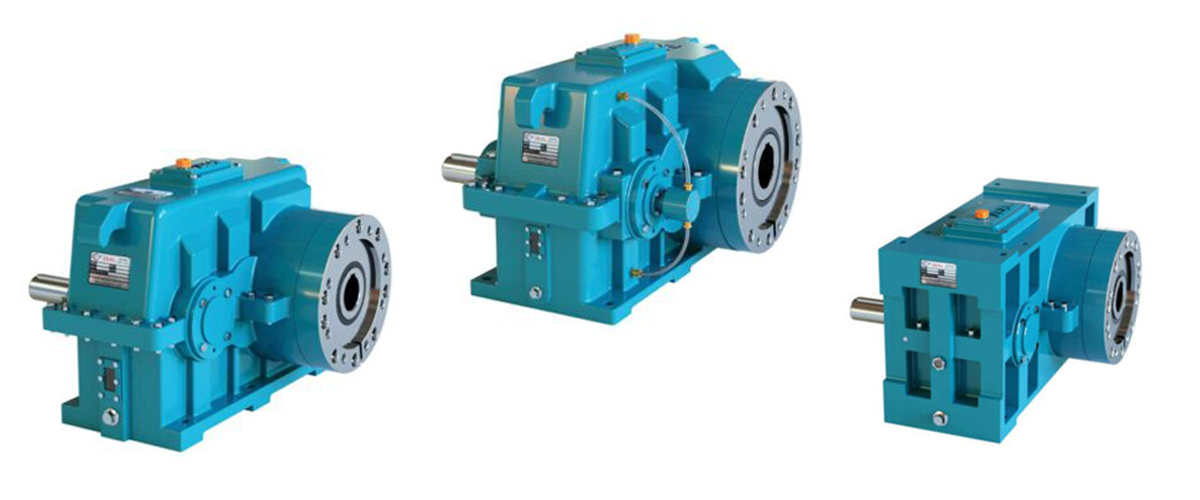
If you want a gearbox that is engineered specifically for the torque and thrust demands of plastic pipe extrusion rather than adapted from a general industrial unit, Zeal Gears’ extruder helical gearbox range is built around exactly this application. The SG, SGH, SZ, and SZH series helical gearboxes are manufactured in graded cast iron housings with oil-resistant internal coating and are available in single-stage, two-stage, and two-stage-with-oil-pump configurations to match different duty levels on HDPE, PVC, CPVC, and PP-R pipe lines.
Across the range, output torque runs from 265 Nm up to 36,700 Nm, with rated power from 4.2 kW to 565 kW at a standard 1500 rpm input speed — covering everything from small-diameter conduit pipe lines to large HDPE water and gas pipe production. Every unit is fitted with an inbuilt thrust block suitable for spherical roller thrust bearings to absorb axial die back-pressure, incorporates copper-alloy cooling coils to manage continuous-duty heat, and is available in single-screw, twin-screw, universal-mounting, and vertical-mounting configurations.
As an ISO 9001 certified manufacturer with more than 15,000 installations across 2,000-plus cities, Zeal Gears runs every gear unit through a no-load test before dispatch and maintains an in-house repair and rebuilding department for genuine spare-part support over the gearbox’s working life. Our engineering team also offers pre-purchase gearbox selection guidance to help you match torque, thrust, and ratio to your specific pipe line rather than sizing off a generic catalogue figure.
Maintenance Tips to Extend the Life of Your Pipe Extrusion Gearbox
A correctly-sized gearbox still needs disciplined maintenance to reach its full service life on a continuous-duty pipe line. These are the practices that matter most.
Lubrication Schedule
Gearboxes are typically supplied without oil pre-filled, so the first and most critical step is filling with the manufacturer-recommended lubricant grade before commissioning — running a gear unit dry, even briefly, causes irreversible tooth-surface damage. On a continuous-duty pipe line, oil condition should be checked at scheduled intervals and changed based on running hours and oil analysis rather than a fixed calendar date, since heat and contamination accumulate faster under 24/7 operation than in intermittent-duty applications.
Alignment and Vibration Checks
Misalignment between the gearbox output shaft and the extruder screw shaft is amplified along the length of the screw, causing uneven barrel wear and premature bearing wear inside the gearbox itself. Regular alignment checks, along with monitoring for abnormal vibration or noise, catch developing problems while they are still a bearing adjustment rather than a full gear-train replacement.
Thermal Monitoring
Since thrust bearing fatigue and oil breakdown are both temperature-driven, tracking gearbox running temperature over time gives an early warning of developing problems — a slow upward drift usually points to a lubrication or cooling issue long before it becomes a failure. Bright shaft ends protected with anti-rust compound should only be cleaned with thinner or a suitable solvent during installation or maintenance; abrasive tools such as emery paper damage the ground surface finish and accuracy the bearings depend on.
Common Mistakes to Avoid When Selecting an Extrusion Gearbox
- Sizing on power (kW) alone: Output torque, not motor power, is what determines whether a gearbox survives your process — two gearboxes on identical motors can have very different torque ratings depending on gear ratio.
- Ignoring the cold-start torque spike: Sizing only to steady-state running torque misses the 20–40 percent peak that occurs during start-up with cold material or a restrictive die.
- Treating the service factor as optional: Skipping or under-applying the service factor is the single most common cause of a gearbox that looks correctly rated on paper but fails early in the field.
- Underestimating thrust bearing requirements: Torque capacity gets the attention, but thrust bearing fatigue is frequently what actually ends a pipe extrusion gearbox’s service life first.
- Choosing mounting configuration as an afterthought: Retrofitting a mismatched mounting orientation later is far more expensive than specifying the correct one at purchase.
- Overlooking cooling needs for your ambient conditions: A gearbox with splash lubrication that works fine in a temperate climate can overheat on a hot factory floor running multiple shifts — always confirm cooling provision against your actual operating environment.
- Choosing on price without checking testing and certification: A lower purchase price rarely accounts for the downtime cost of an early failure; ISO 9001 certification and documented no-load testing are practical indicators of consistent manufacturing quality.
Frequently Asked Questions
Q1. What torque rating do I need for a gearbox on a 63mm to 200mm HDPE pipe line?
It depends on output rate, die restriction, and material grade rather than screw diameter alone, but as a rough planning range, small-diameter conduit lines often need gearboxes rated from roughly 500 to 2,000 Nm, while larger 160–200mm HDPE pipe lines commonly need 3,000 to 8,000 Nm or more. Always confirm with a torque calculation using your specific output target and die, then apply the appropriate service factor before finalising the rating.
Q2. Should I choose a single-stage or two-stage gearbox for pipe extrusion?
Single-stage gearboxes suit smaller-diameter, lower-torque pipe lines where a modest reduction ratio is sufficient. Two-stage gearboxes are the standard choice for most mid-to-large HDPE and PVC pipe lines because they deliver higher torque and reduction ratio within a compact footprint, and typically include the thrust block needed for die back-pressure.
Q3. How is thrust bearing capacity calculated for a pipe extrusion gearbox?
Thrust bearing capacity is matched against the axial back-pressure force generated at the die, which depends on screw diameter, melt pressure, and screw speed, along with your required bearing service life. Your gearbox supplier should provide permissible axial force charts at different speeds and target bearing lives so you can verify the bearing against your actual process conditions rather than a generic rating.
Q4. Can one gearbox handle both HDPE and PVC pipe extrusion on the same line?
Often yes, provided the gearbox was sized for the higher torque demand of the two materials — rigid PVC compounds typically require more torque at a given screw speed than HDPE. If your line regularly switches between materials, apply a higher service factor at the selection stage to cover the more demanding material rather than sizing to an average figure.
Q5. What gear ratio is ideal for a pipe extrusion line?
The ideal ratio matches your motor’s rated speed, commonly 1500 rpm, to the screw speed your process needs, which typically falls between 15 and 150 rpm depending on pipe diameter and output target. Since a higher ratio increases torque at the cost of speed, the correct ratio is the one that meets your torque requirement at the screw speed your recipe and die actually demand.
Q6. How much does an extruder gearbox for pipe extrusion cost in India?
Cost varies widely with torque rating, configuration (single-stage versus two-stage with oil pump), and customisation, so a meaningful figure requires your specific torque, thrust, and mounting requirements. Contact Zeal Gears with your line’s output target, screw diameter, and material to get an application-specific quotation rather than relying on a generic price range.
Q7. What’s the difference between vertical mounting and universal mounting gearboxes?
Vertical mounting gearboxes position the drive vertically to save floor space and simplify screw removal, and are common on larger installations. Universal mounting gearboxes, often with an input flange, are designed for flexible horizontal offset installation where motor alignment and barrel height constraints make a vertical layout impractical.
Q8. How often should I change gearbox oil in a 24/7 pipe extrusion line?
Because continuous duty accumulates heat and contamination faster than intermittent operation, oil condition should be checked on a running-hours basis and confirmed through periodic oil analysis rather than a fixed calendar interval. Follow the manufacturer’s recommended interval as a baseline, but shorten it if analysis shows accelerated additive depletion or particulate contamination.
Q9. What causes gearbox overheating in pipe extrusion machines?
The most common causes are inadequate cooling provision for the duty cycle, insufficient or degraded lubrication, and bearing distress that increases internal friction. Persistent overheating despite correct oil level and grade usually points to an undersized cooling system relative to continuous-duty heat generation, or a developing thrust bearing problem that needs inspection.
Q10. Is a twin-screw gearbox necessary for pipe extrusion, or is single-screw enough?
Most standard HDPE, PVC, and PP-R pipe lines run efficiently on single-screw gearboxes, which are simpler, more cost-effective, and easier to maintain. Twin-screw gearboxes are typically reserved for compounding-fed or heavily filled rigid PVC pipe production where more uniform, higher torque delivery is needed than a single screw can provide.
Q11. What service factor should I use for a pipe line with frequent size changeovers?
Lines with frequent starts, stops, or diameter changeovers should generally use a service factor toward the higher end of the 1.5 to 2.0 range, rather than the 1.25 baseline used for steady, single-product continuous duty. This accounts for the repeated cold-start torque spikes that a changeover schedule introduces.
Q12. How do I know if my existing gearbox is undersized?
Warning signs include rising oil temperature under normal ambient conditions, abnormal gear noise or vibration, visible wall-thickness variation in the finished pipe traceable to output-speed instability, and more frequent-than-expected bearing or seal replacement. If several of these appear together, a torque and thrust recalculation against your current process parameters is worth doing before the next scheduled replacement.
Q13. What certifications should a gearbox manufacturer have?
ISO 9001 certification for quality management is the practical baseline to look for, alongside documented no-load testing of every unit before dispatch and gear rating calculated to a recognised standard such as DIN 3990. These don’t guarantee performance on their own, but they are reliable indicators of a consistent, controlled manufacturing process.
Q14. Can Zeal Gears customize a gearbox for my existing pipe extrusion line?
Yes. Zeal Gears offers customised gear ratios, shaft dimensions, mounting configurations, and flange patterns to match an existing extruder, which is often more cost-effective than modifying the extruder to fit a standard gearbox. Share your current gearbox’s dimension sheet and your process torque requirement to start a customisation review.
Q15. What’s the typical lead time for a new pipe extrusion gearbox?
Lead time depends on whether the required torque rating and configuration are held in standard production or require custom engineering, with standard configurations generally shipping faster than fully customised units. Contact Zeal Gears directly with your torque, ratio, and mounting requirement for a project-specific delivery timeline.
Conclusion
Selecting the best gearbox for plastic pipe extrusion machines comes down to five decisions done in the right order: calculate real torque demand from your screw and process data, identify the worst-case load point rather than the average, apply an honest service factor, verify the thrust bearing against actual die back-pressure, and only then choose the mounting configuration that fits your line layout. Skip any one of these and you risk a gearbox that looks correctly specified on paper but fails well short of its expected service life on the shop floor.
Zeal Gears has engineered helical gearboxes for the plastic pipe extrusion industry for years, with a product range covering 265 Nm to 36,700 Nm of output torque across single-stage, two-stage, twin-screw, and multiple mounting configurations. If you’re specifying a new pipe extrusion line or replacing an underperforming gearbox, get in touch with our engineering team for an application-specific torque and thrust calculation before you finalise your order.
